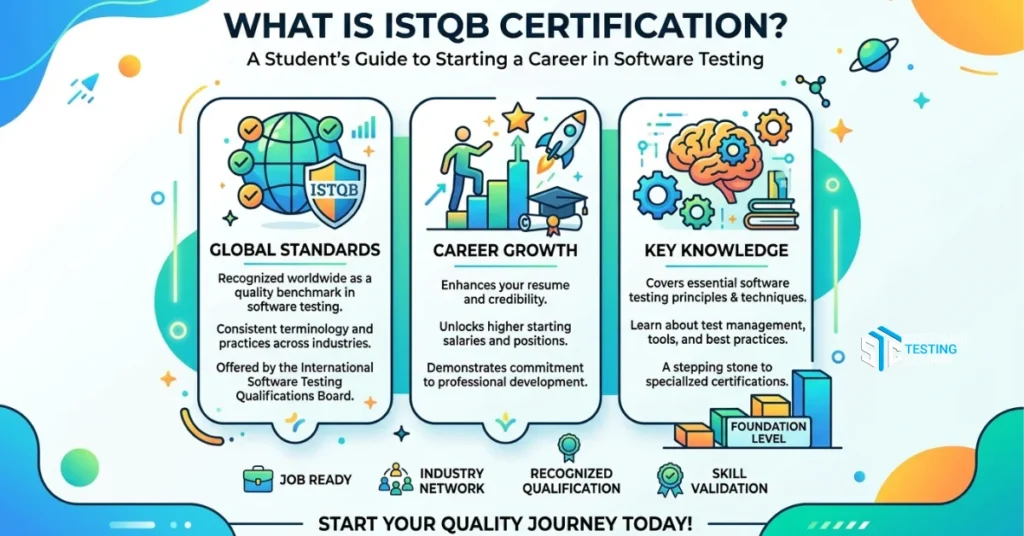
If you wish to kick-start your career in software testing in Australia, the best course of action is to opt for the ISTQB Foundation Level certification. It provides in-depth knowledge of software testing concepts, techniques, and best practices, ensuring you are ready for real-world projects as well as the exam. By 2026, ISTQB will remain the most trusted certification in the industry.
Whether you are in Sydney, Melbourne, Brisbane, or remote parts of Australia, you can easily access the complete ISTQB Foundation Level syllabus on the Software Testing Course. Our guide presents the syllabus in a clear, structured, and practical way, with a touch of humour to make learning enjoyable. Contact us for more info and start your journey to mastering software testing today.
What is ISTQB Foundation Level?
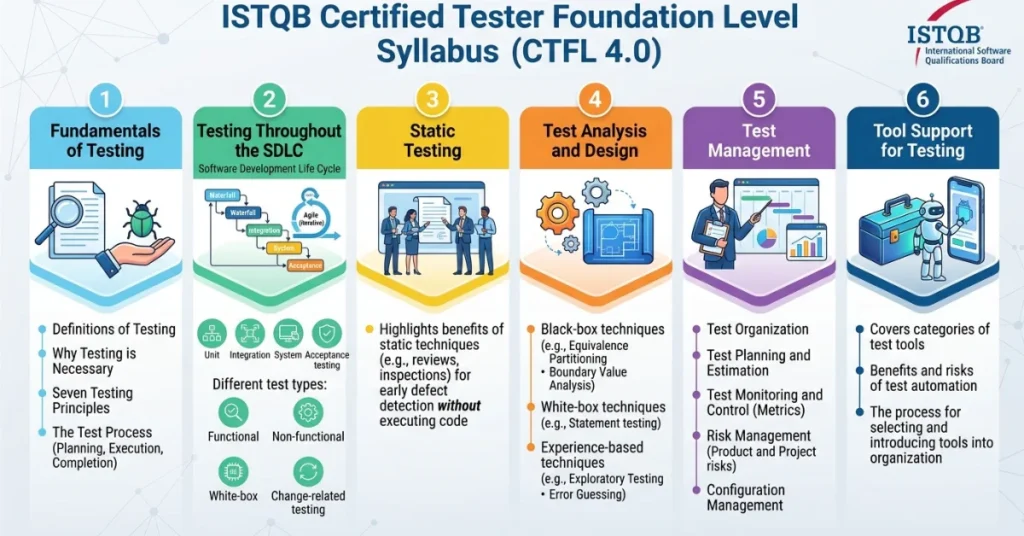
- Fundamentals of software testing
- Testing throughout the software development lifecycle
- Static techniques
- Test design techniques
- Test management
- Tools support for testing.
Why ISTQB Foundation Level is Relevant in 2026
- Understand modern testing techniques.
- Can integrate automated tools
- Know how to design effective test cases.
- Can think critically about risks
Key Components of the ISTQB Foundation Level Syllabus
1. Fundamentals of Testing
- Why testing is necessary
- Basic testing principles
- Differences between error, defect, and failure
- The psychology behind testing
2. Testing Throughout the Software Lifecycle
- Test levels: unit, integration, system, and acceptance
- Test types: functional vs non-functional
- How testing strategies differ across lifecycle models
3. Static Techniques
- Reviews (formal, informal, walkthroughs)
- Static analysis tools
- Benefits of detecting defects early
4. Test Design Techniques
- Black-box testing: Testing without looking at the code, focusing on inputs and outputs
- White-box testing: Testing with knowledge of the code structure
- Experience-based testing: Using intuition and prior experience to detect defects
5. Test Management
- Test planning
- Risk-based testing
- Test estimation and monitoring
- Defect management and reporting
6. Tools Support for Testing
- Test management tools (e.g., JIRA, TestRail)
- Automation basics (e.g., Selenium, Postman)
- Static analysis tools
How to Prepare for ISTQB Foundation Level in Australia
- Understand the syllabus: Download the latest syllabus from the official ISTQB website. Make sure you study the 2026 updates.
- Use sample papers: Practice with official mock exams to familiarise yourself with question patterns.
- Join local communities: Testers in Australia often share tips on LinkedIn, Meetup groups, or forums like Stack Overflow. Networking helps you learn real-world applications.
- Focus on logic, not memorisation: Many candidates fail because they memorise answers rather than understand the concepts. ISTQB exams reward critical thinking.
Tips for Passing the ISTQB Foundation Exam
- Read questions carefully: The exam is full of tricky wording.
- Manage your time: 40 questions in 60 minutes—don’t get stuck on one.
- Understand key terms: Know the difference between a test plan, test case, and test scenario.
- Use practical examples: Think of Australian projects you know—this helps retain knowledge.
Career Benefits of ISTQB Foundation Level
- Software Tester: Entry-level, but in high demand.
- QA Analyst: Focus on quality across projects.
- Automation Tester: Especially in tech hubs like Sydney or Brisbane.
- Test Lead/Manager: After gaining experience and advanced certifications.
Common Misconceptions About ISTQB
- “It’s only for beginners” – Not true. Even senior testers benefit from revisiting fundamentals.
- “It guarantees a job” – Certification improves chances, but real-world experience still matters.
- “It’s only about tools” – ISTQB focuses on principles first; tools are secondary.
Australian Context: Why It Matters Locally
- Follow international standards
- Can integrate testing in agile environments
- Understand regulatory compliance (e.g., privacy, security)
Resources for ISTQB Foundation Level Preparation
- Official ISTQB Syllabus 2026
- Sample Exam Papers
- Local Australian testing forums and Meetup groups
- Books: Foundations of Software Testing: ISTQB Certification by Dorothy Graham
Final Thoughts
Frequently Asked Questions
What is the ISTQB Foundation Level certification?
The ISTQB Foundation Level certification is an entry-level qualification that validates your basic knowledge of software testing principles, techniques, and terminology. It covers topics such as fundamentals of testing, lifecycle testing activities, static testing, test design techniques, test management, and tools support. This certification is recognised globally and is ideal for beginners, testers switching careers, and professionals who want a solid foundation in testing concepts.
How many questions are in the ISTQB Foundation Level exam, and what is the pass mark?
The ISTQB Foundation Level exam consists of 40 multiple-choice questions, and you must score at least 65% (which is 26 correct answers) to pass. This format helps ensure that candidates understand the key syllabus areas and terminology rather than just memorising answers.
Do I need any prerequisites to take the ISTQB Foundation Level exam?
No formal prerequisites are required to sit the ISTQB Foundation Level exam. Anyone interested in software testing can register, though having a basic understanding of software development or exposure to testing concepts can help you prepare more effectively.
Is the ISTQB Foundation certification valid for life?
Yes, once you earn the ISTQB Foundation Level certificate, it does not expire and remains valid for life. This means you can keep it on your CV indefinitely, showing future employers that you have foundational testing knowledge. The certification also serves as a prerequisite for more advanced ISTQB qualifications.
Where can I take the ISTQB Foundation Level exam in Australia?
In Australia, you can take the ISTQB Foundation Level exam either online from home or office or at physical test centres located in major cities such as Sydney, Melbourne, Brisbane, Perth, Adelaide, Canberra, and Darwin. You schedule and sit the exam through authorised providers like AT*SQA, with flexible dates available once you purchase your exam voucher.