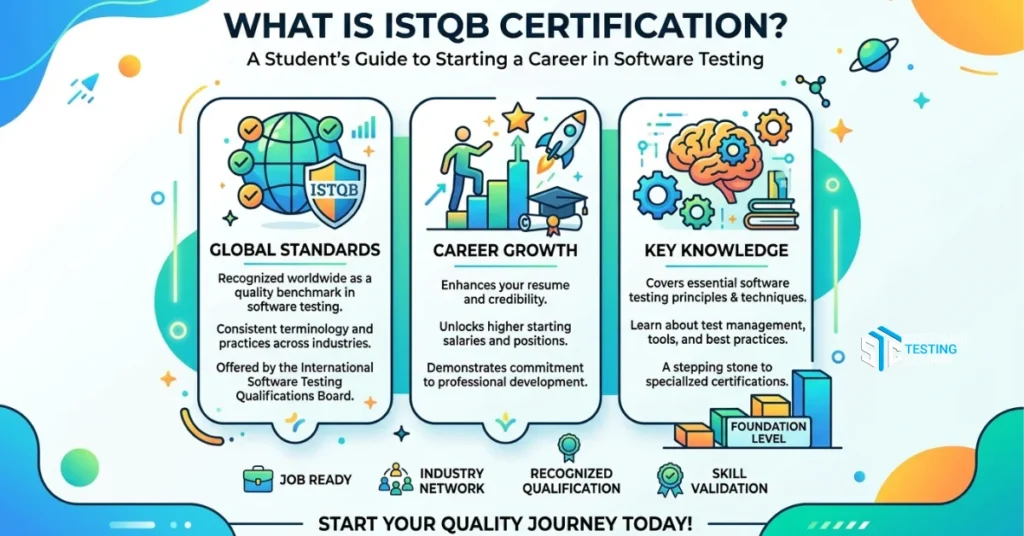
If you are planning to enrol in 2026 and want a quick answer, here it is: ISTQB Foundation in Australia is the entry-level software testing qualification in the global ISTQB scheme, supported locally by the Australia & New Zealand Testing Board (ANZTB). At Software Testing Course Institute in Australia, we see it as one of the clearest starting points for students who want to build real software testing knowledge in 2026. It covers the fundamentals of software testing, includes a 40-question multiple-choice exam, requires 26 correct answers to pass, has no formal prerequisites, and can be taken in Australia through ANZTB’s exam delivery partner, iSQI, either at a Pearson VUE test centre or through remote proctoring.
What does ISTQB Foundation certification actually mean?
ISTQB is an acronym that stands for International Software Testing Qualifications Board. The first qualification in the series is called the Foundation Level and is also referred to as the CTFL. In other words, it is an introduction to the basics of software testing and how it is used. It is not a qualification that is flashy and has no real substance. It is the first qualification in the ISTQB Certified Tester series.
In Australia, the local ISTQB is called ANZTB. ANZTB says that it is the local provider of ISTQB qualifications in Australia and New Zealand. It has been a non-profit member board since 2005. This is important because students in Australia want two things: a global qualification and a local way of accessing the exam. ANZTB provides that.
Why are students in Australia looking at it in 2026?
The reason students are looking at the ISTQB Foundation Course in 2026 is that software testing is a real job, not something people dream up on Friday night when the app breaks. Jobs and Skills Australia includes Software Testers as a recognised occupation. Their description of the occupation includes writing test plans and scripts, writing test cases, performing regression testing, using test software, and documenting defects. Their most recent occupation profile also indicates that there are 9,100 employed software testers in Australia.
That doesn’t mean that one certificate guarantees employment. What it means is that there is a recognised role in the marketplace. And that is important for students. If you want a career in QA, testing, business analysis, software delivery, or a junior technology job that involves quality in some way, CTFL is a recognised way in and provides the right language. It helps you understand how people talk about risk, defects, coverage, reviews, and test design without sounding like you learned software testing from random internet sources.
What do you learn in the ISTQB Foundation?
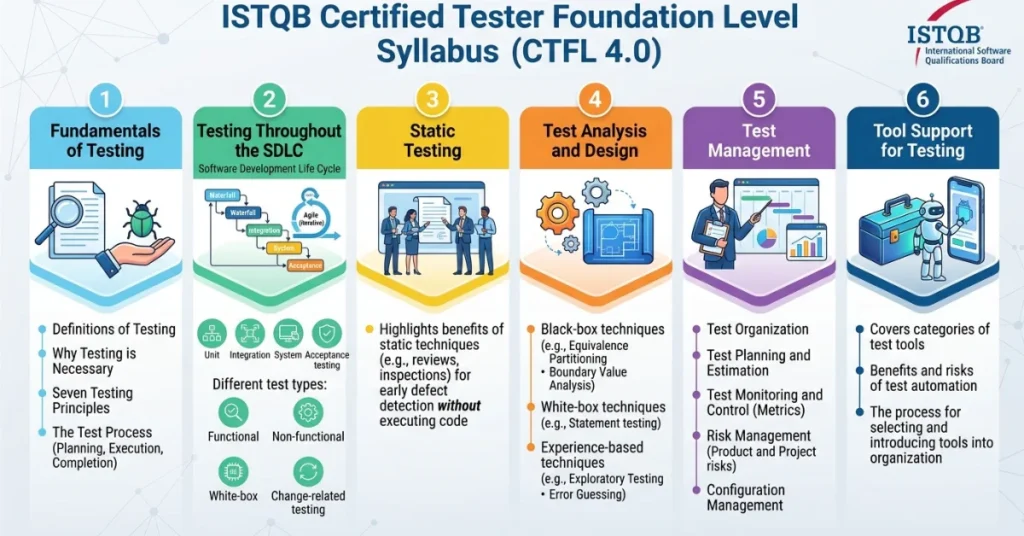
The CTFL v4.0 syllabus includes the basic concepts of software testing. Some of the basic concepts of software testing, as per the ISTQB syllabus, are Fundamentals of Testing, Testing Throughout the Software Development Lifecycle, Static Testing, Test Analysis and Design, Managing the Test Activities, and Test Tools. It also includes the concepts of black box, white box, experience-based, and collaborative-based methods.
The reason for this is that modern software development teams in Australia may not follow the same style of development. Some may stick to traditional approaches, while others use Agile methodology, and some operate in a mix of Agile, DevOps, and Continuous Delivery practices. As per the ISTQB syllabus, the CTFL course remains relevant across Waterfall, Agile, DevOps, and Continuous Delivery, so it doesn’t restrict students to one methodology. For those who want to specialise further, the Agile Tester course offered at Software Testing Course Institute in Australia is an excellent next step, providing practical skills for Agile environments and helping students decide which methodology suits them best.
The syllabus also aims at practical outcomes, not just memory work. ISTQB says successful candidates should understand what testing is, choose suitable test approaches for a context, assess documentation quality, report defects clearly, understand test management principles, and recognise the risks and benefits of test automation. In other words, the course tries to teach you how to think like a tester, not just how to survive an exam room with sweaty palms and a ticking clock.
How does the ISTQB Foundation exam work in Australia?
The current Foundation Level overview states that the exam has 40 questions, a passing score of 26, 40 total points, and a standard length of 60 minutes, with 25% extra time for non-native language candidates. ISTQB also states that Foundation exams use multiple-choice questions and cover K1 to K3 knowledge levels.
One of the best things for new students is this: CTFL has no prerequisites. You do not need an older certificate first. You do not need years of industry experience. You do not even need software development skills to be eligible, although ISTQB strongly recommends proper preparation before you sit the exam. That makes CTFL one of the more accessible certifications for students and career changers in Australia.
For exam delivery in Australia, ANZTB says bookings now run through its exam partner iSQI. ANZTB also says candidates can sit the exam at a Pearson VUE test centre or use a remote proctored solution from home. That flexibility helps 2026 students, especially those balancing uni, work, commuting, and the eternal Australian classic of saying “I’ll study this weekend” and then not doing it.
Another point students often miss: ISTQB certificates have lifelong validity. ISTQB says your certificate does not expire. That does not mean you should stop learning. It means the credential stays valid while the industry keeps moving. If you want the newest version on your record, you can always sit the current syllabus later.
Who should enrol in 2026?
If you study IT, computer science, information systems, or software engineering, CTFL makes sense when you want a clearer grip on quality and testing. It also suits students who want junior QA roles, graduate tech roles, or entry-level project and delivery work where testing knowledge helps. ISTQB says the audience includes testers, test analysts, test engineers, consultants, test managers, user acceptance testers, and software developers. It also names project managers, quality managers, business analysts, IT directors, and management consultants as people who can benefit from a basic understanding of testing.
That broad audience matters in Australia because many graduates do not step into a role called “Software Tester” on day one. Some join product teams. Some start in support, business analysis, QA coordination, or development. CTFL gives those students a shared testing language and a structured way to understand quality work across teams. ANZTB highlights that a common language is one of the key reasons to pursue ISTQB certification.
What the ISTQB Foundation is not
Let’s be logical. ISTQB Foundation is not a magic solution that guarantees a job. It is not a substitute for a degree, project experience, interview skills, and practice. And it is not a solution that promises to turn you into an automation engineer overnight. CTFL includes the benefits and risks of test automation. However, it doesn’t pretend that it is going to teach in-depth coding skills and advanced automation frameworks in the foundation course.
And that is not a weakness. That is exactly the point. The foundation course is designed to provide a solid foundation in the first place. Too many students are eager to jump at tools, frameworks, and methodologies because they sound cool. And then, in an interview, someone asks them about test design, defect reporting, and risk-based testing. And suddenly, the room is quieter than an online group project discussion where someone says, “Who wants to be in charge?”
How should students prepare in 2026?
ISTQB states that candidates may choose this by means of an accredited training program or self-study, though they recommend the first method as the best way, as a recognized member board reviews the study material for consistency and relevance to the syllabus. However, ISTQB states that self-study is an alternative, though only if the candidate makes use of the official syllabus and recommended reading.
For students in Australia, the smart way to go about the exam is as follows: the student may make use of the official syllabus, the ISTQB glossary, as well as the official sample exams, before deciding whether they should make use of an accredited training program. If the student is the type that needs deadlines, a trainer, as well as class support, then the student may benefit from an accredited training program, though if the student is the type that studies well on their own, then self-study is an alternative, as long as the student makes use of the official study material, as opposed to the mystery study notes of some unknown individual who claims that they “totally remember the exam”.
ANZTB also notes that online mock exams for CTFL 4.0 are available through iSQI. That can help students test their timing and get used to the question style before the real exam. Practice matters here because knowing a concept and answering a timed multiple-choice question about it are not always the same sport.
Is ISTQB Foundation worth it in Australia?
For many students, yes. It makes the most sense in cases where one requires a recognised foundation, a way to get into software testing and QA, and a better understanding of quality in software teams. ANZTB points out that ISTQB provides global recognition, a common professional vocabulary, verification of competencies in an objective manner, public access to syllabi and glossary material, and a non-profit and independent framework for certification. These are important points because they explain the value of the certificate beyond one training provider and one local ad.
The certificate also has a strong global presence. ANZTB points out that, as of June 2024, ISTQB has administered over 1.4 million exams and awarded over 995,000 certifications in 130 countries. While this doesn’t prove that every employer will be concerned with the same degree, it does prove that the program has depth and staying power. This is important for Australian students who may work locally and internationally.
The better question, then, is not “Is CTFL perfect?” It is “Does CTFL fit my next step?” If you want a solid entry point into testing, the answer is often yes. If you already have deep testing experience, strong automation skills, and several years in delivery teams, Foundation may feel basic. For most students planning to enrol in 2026, though, basic is not an insult. Basic is where strong careers usually start.
Final word
So, what is the ISTQB Foundation certification in Australia? It is the entry-level ISTQB software testing certification, delivered via ANZTB routes, aimed at teaching the basics of software testing, and accessible to students as it has no prerequisites. In 2026, it is a viable choice for Australian students who want to gain knowledge in software testing, speak the language of quality with confidence, and embark on a pathway of international certification without making wild claims about what one certificate is supposed to accomplish. That is exactly what the balance of the CTFL certification is.
Primary Sources: ISTQB official certification website, ANZTB official website for Australia/New Zealand, and the Jobs and Skills Australia website.
Frequently Asked Questions
Is the ISTQB Foundation certification accepted in Australia?
Yes. ISTQB Foundation certification is recognised in Australia through ANZTB, the official local board, so it gives students a trusted and globally known starting point in software testing.
Can Australian students take the ISTQB Foundation exam without experience?
Yes, they can. You do not need industry experience to sit the exam, which makes it a practical option for uni students, TAFE students, and fresh graduates in Australia.
Why do Australian students choose the ISTQB Foundation in 2026?
Many students choose it to build job-ready testing knowledge before applying for graduate or junior tech roles. It also helps them understand QA terms used by Australian employers.
How do you sit the ISTQB Foundation exam in Australia?
In Australia, students can usually book the exam through the official local pathway and sit it either online with remote proctoring or at an approved test centre, depending on availability.
Is ISTQB Foundation worth it for entry-level tech jobs in Australia?
Yes, for many students it is worth it. It shows employers that you understand software testing basics and gives your resume extra value when you are starting out in the Australian tech market.