
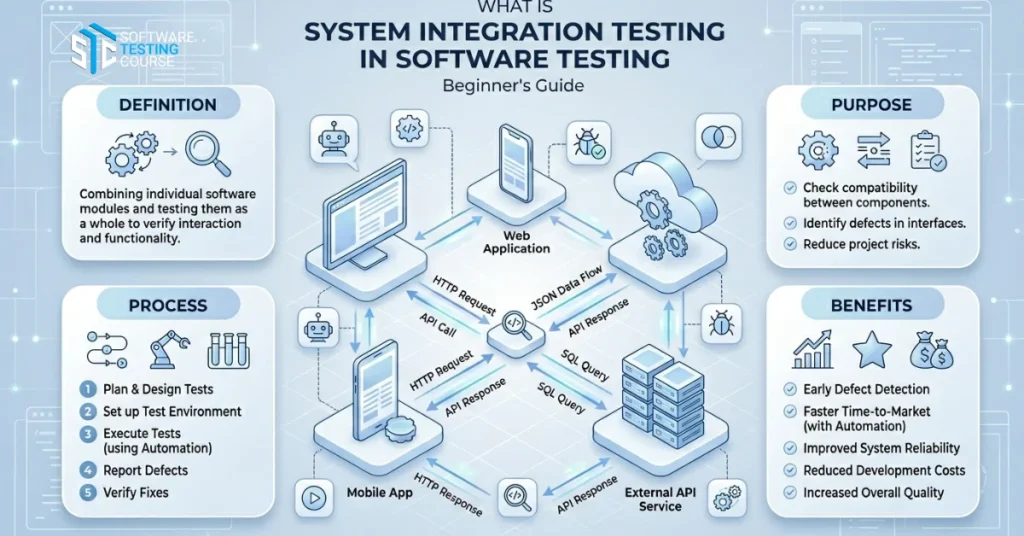
System integration testing (SIT) verifies that the various parts of a software system work together smoothly after integration. It ensures that data flows correctly and that modules communicate effectively. It is not just that each part works on its own.
If one had created an application in the past that works fine in isolation but cannot work together in real-world applications, then the importance of SRE becomes clear. This can be thought of as ensuring that everything works before bringing the whole application online.
What System Integration Testing Really Means
SIT testing is an important stage in the SDLC process. Once developers have tested individual pieces, referred to as unit testing, the tests for the system as a whole follow. The aim of this procedure is to detect errors that cannot be seen when working with separate pieces but may appear when different modules interact, including issues with data transfer format, communication failures between services/APIs, and behavior when passing information from one component to another.
Despite the development of technologies, including the widespread use of APIs, microservices, and third-party applications in 2026, this stage of testing will remain relevant, as the module can function flawlessly until it integrates with other components.
Why It’s Important (Especially for Aussie Developers)
Here’s why software system integration testing should be on every Australian software team’s radar:
Finds Issues Others Miss
While unit testing ensures that every component functions properly on its own, SIT ensures that they function properly together. Despite each component being flawless, integration issues can arise from interactions between components regarding data sharing and process initiation.
Reduces Risk Before Release
The last thing you would want is for the application that you created to fail during its launch simply because the database component did not interface well enough with the payment processor. The SIT testing will prevent this from happening.
Bridges Gaps in Modern Systems
The present software is not created as a monolithic piece. It is made up of several components, such as services, APIs, and microcomponents. SIT validates their integration, which is essential tools for software testing, DevOps, CI/CD, and agile tester.

Improves Confidence in Software Quality
For teams working in Sydney, Melbourne, or Perth, system integration testing ensures there will be no problems for users, such as system crashes or data mismatches.
How It Fits into the Software Testing Process
It helps to picture testing as a spectrum:
Unit Testing – Tests small pieces in isolation
Integration Testing (SIT) – Tests how the combined pieces interact
System Testing – Tests the application as a complete, unified system
Acceptance Testing – Confirms the product meets business goals and user needs
SIT usually happens after unit testing and before system or acceptance testing.
What System Integration Testing Checks
SIT focuses on:
Interfaces between modules – Are messages, data, and calls flowing smoothly?
Data integrity – Are values preserved correctly as they pass through components?
APIs and services – Do external services behave as expected under real use?
Communication errors—Garbage in, garbage out — is still a thing—SIT spots it.
In the event of transmission of incompatible data types from any module or of an API modification, SIT should identify this problem prior to customer discovery.
Common Approaches to System Integration Testing
There are a few established ways to perform integration testing, depending on how complex the system is:
Big‑Bang Integration
Modules are integrated as a whole and tested. This is easy but difficult to implement in large systems since you never know where the fault originated.
Top‑Down Integration
The testing process starts with top-level modules, then gradually proceeds to bottom-level ones. This method can identify serious problems earlier.
Bottom‑Up Integration
Testing starts with basic modules and progresses to a complete system. It is effective when the bottom modules are stable.
Hybrid (Sandwich)
A mixture of top‑down and bottom‑up is good for large or complex applications.
Example You Can Relate To
Consider an application for booking travel developed in Australia:
- The customer chooses an airplane.
- The booking application sends customer details to the payment gateway.
- The payment gateway interacts with the banking services.
- Once the transaction is complete, the booking services update the customer’s profile.
Even though all these modules operate individually without any problems, when they are made to interact, you may encounter errors such as payment verification failures, booking updates not being applied, or missing customer information. SIT will model this realistic scenario to ensure that the application operates as intended.
Best Practices for 2026
Here’s how modern Aussie teams are improving system integration testing:
Use Realistic Test Data
Mock data is ideal for unit testing, whereas real data is best suited for integration testing.
Automate Where It Makes Sense
Automation tests can save time and automatically prevent regression bugs in the development process.
Keep Environments Close to Production
Integration tests will prove most helpful when real-like situations and scenarios are reproduced in the testing environment.
Test APIs and Dependencies Explicitly
The areas that usually cause problems are external services, third-party API calls, and identity boundaries. It goes without saying that one should test APIs nowadays because we use them everywhere.
System Integration Testing vs System Testing
They both seem alike but are quite different:
- System Integration Testing emphasizes the interaction between integrated modules.
- System Testing concentrates on validating the entire system according to its requirements (functional & non-functional).
In short, System Integration Testing is like inspecting the connections, whereas System Testing is verifying that the whole machine works properly.
Conclusion
It is one of the most important phases that connect the development of individual software elements with testing their interaction. It is at this point that many defects that would otherwise go unnoticed until the customer finds them are revealed. As systems become more modular and third-party-integrated, system integration testing will be a core part of QA in 2026.
Frequently Asked Questions
-
What is system integration testing?
System Integration Testing (SIT) verifies that the combined software modules function as intended and that data and communication handling are handled properly among the modules.
-
When should integration testing be done?
This type of testing comes after unit testing but before system testing.
-
How is system integration testing different from system testing?
Integration testing involves testing of interactions between components, whereas system testing ensures the complete functionality of the application.
-
Why is integration testing important?
It uncovers problems such as data-handling issues and interactions between units that cannot be uncovered by unit testing alone.
-
What kinds of problems does SIT typically uncover?
SIT tests for problems like interface mismatch, problems in data transfer and handling, API failures, and erroneous behavior between components.
-
What is a common approach used in integration testing?
Incremental integration (adding modules step by step) and big‑bang integration (testing all at once) are widely used methods depending on project needs.