


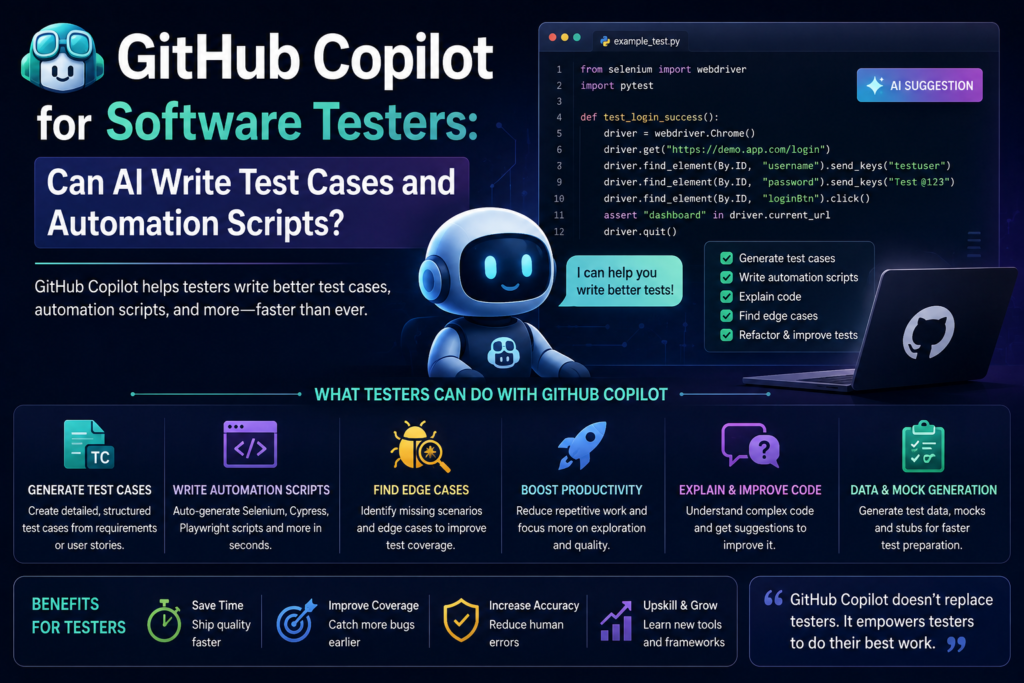
GitHub Copilot software testers is quickly becoming part of the everyday QA toolkit but the honest answer to “can AI write test cases and automation scripts” is: yes, partly, and only well when a skilled tester is directing it. This guide looks at exactly where GitHub Copilot genuinely speeds up software testing work, where it falls short, and what Australian QA engineers need to know to use it properly rather than blindly.
Whether you’re testing software in Sydney, Melbourne, Brisbane, Perth, Adelaide or Canberra, the tools are the same what differs is how well your team understands testing fundamentals well enough to check Copilot’s work.
What Is GitHub Copilot?
GitHub Copilot is an AI pair-programming tool built into code editors like VS Code and JetBrains IDEs. It suggests code, including test code, based on the surrounding context, comments, and natural-language prompts. For software testers, this means Copilot can draft test scaffolding, suggest assertions, and generate boilerplate automation code far faster than typing it manually.
Copilot isn’t a testing tool in the way a test management platform or a defect tracker is it’s a code-generation assistant that happens to be very useful when applied to test scripts, because so much of test automation code is repetitive and pattern-based.
Can GitHub Copilot Write Test Cases?
Copilot can draft test case outlines happy path, boundary, negative and edge cases reasonably well when given a clear description of the feature being tested. It’s genuinely useful for getting a first draft of test coverage down quickly. What it can’t reliably do is know your specific business rules, edge cases unique to your domain, or which scenarios actually matter most to your users — that judgement still needs an experienced tester.
In practice, the most effective pattern is: a tester writes a clear feature description and a few example scenarios, Copilot expands that into a broader draft set of test cases, and the tester then reviews, trims and prioritises the list before it goes anywhere near a test plan.
Can GitHub Copilot Write Automation Scripts?
Yes, and this is where Copilot tends to save the most time. Given an existing automation framework Selenium, Playwright or Cypress Copilot can draft new test scripts that follow the same patterns already in your codebase: page object structure, common assertions, and typical setup/teardown code.
It’s particularly strong at reducing the boilerplate involved in writing new Selenium or Playwright tests once a project’s structure is established, since it can pattern-match against existing test files in the repository. See GitHub’s own Copilot documentation for the current supported languages and IDE integrations.
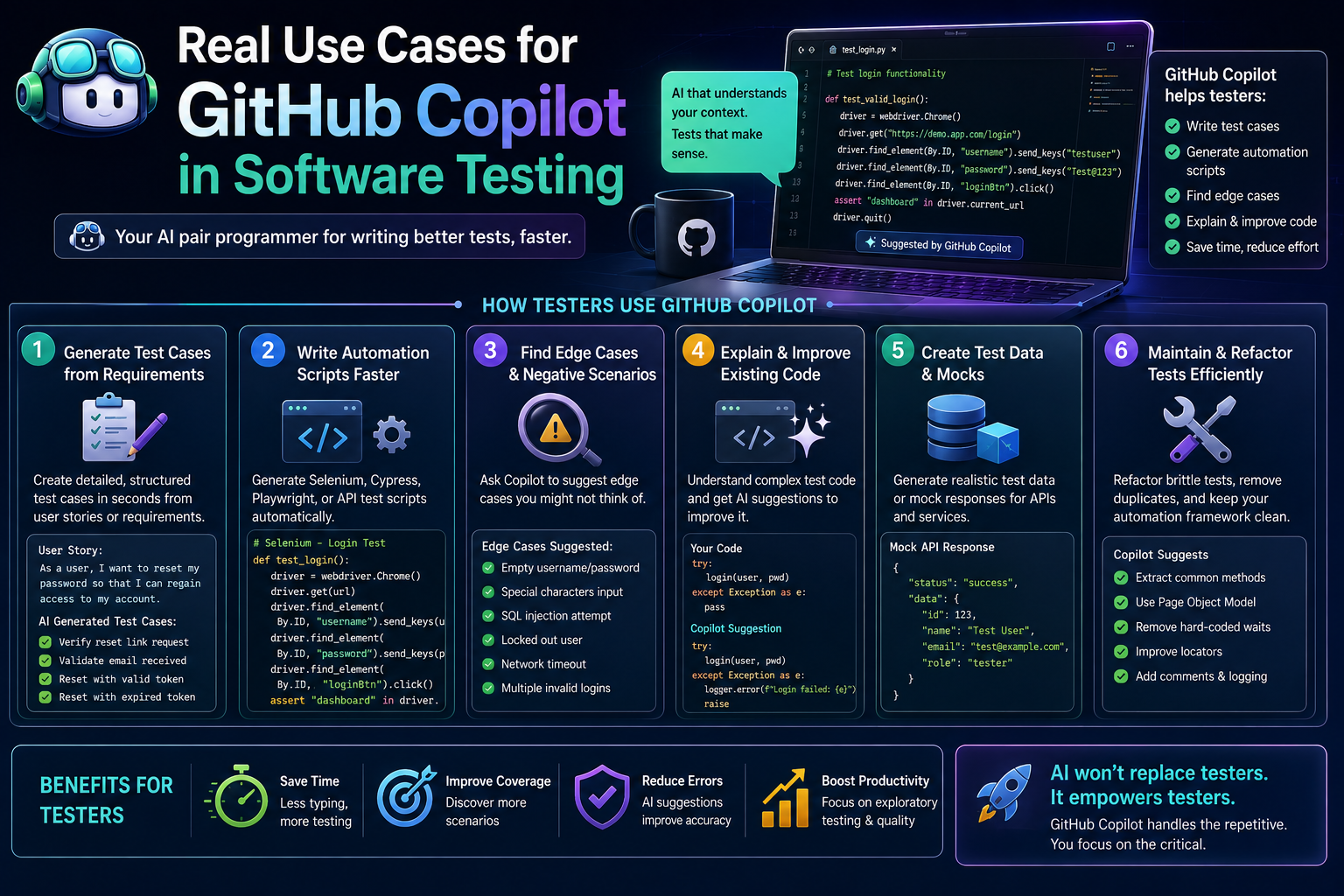
Real Use Cases for GitHub Copilot in Software Testing
| Use Case | What Copilot Does | Tester’s Role |
| Test case drafting | Suggests happy-path, negative and edge-case scenarios | Review, prioritise, add domain-specific cases |
| Automation scripting | Generates Selenium/Playwright/Cypress boilerplate | Validate locators, assertions and stability |
| Test data generation | Creates sample datasets and edge-case input values | Confirm data reflects real production scenarios |
| Debugging failing tests | Suggests likely causes for a failing assertion | Confirm root cause, avoid masking real defects |
| Code review support | Flags obvious issues in test scripts before merge | Final review against test strategy and coverage goals |
Where Human Testers Still Matter Most
- Understanding what the user actually needs, not just what the code technically does.
- Spotting subtle edge cases tied to business rules Copilot has no visibility into.
- Deciding test priority and risk — Copilot can generate many test ideas, but not which ones matter most.
- Catching false-positive “passing” tests that don’t actually validate the right behaviour.
- Maintaining test strategy and coverage across a whole product, not just one script at a time.
How This Fits with Manual and Automation Testing Skills
Copilot is most useful to testers who already understand solid test design it amplifies good testing practice, it doesn’t replace the need to learn it. Our guide to Manual vs Automation Testing is a good starting point if you’re deciding which skill to build first before layering AI tools on top.
For a broader look at how generative AI is changing QA roles beyond just GitHub Copilot, see our guide to AI in Software Testing, which covers ChatGPT and other generative AI use cases across the testing lifecycle.
GitHub Copilot Adoption Across Australia
- Sydney and Melbourne — larger QA teams are integrating Copilot into existing Selenium/Playwright frameworks to speed up regression suite growth.
- Brisbane and Perth — smaller QA teams use Copilot to punch above their weight on automation coverage without extra headcount.
- Adelaide and Canberra — government and regulated-industry testers tend to use Copilot carefully, with strict code review before any AI-generated test reaches production pipelines.
Skills QA Engineers Need to Work Well with Copilot
- Solid test design fundamentals (equivalence partitioning, boundary value analysis) to judge Copilot’s suggested test cases properly.
- Working knowledge of at least one automation framework, so you can validate not just accept generated scripts.
- Basic scripting literacy (JavaScript, Python or Java, depending on your stack) to read and adjust what Copilot produces.
- A recognised QA foundation such as ISTQB certification, which builds the test design knowledge Copilot can’t substitute for.
Build These Skills Through Accredited Training
Start with a strong grounding in ISTQB Foundation testing principles the test design techniques that let you properly evaluate what Copilot suggests.
If you’re deciding between manual and automation specialisations, our Manual vs Automation Testing guide breaks down which to prioritise first.
For career and pay context, see our QA Engineer Salary Australia guide testers who can competently direct AI tools like Copilot are increasingly valued in the market.
Explore accredited software testing courses at Logitrain, delivered across Sydney, Melbourne, Brisbane, Perth, Adelaide and Canberra, both in person and online.
Frequently Asked Questions
Can GitHub Copilot fully replace a software tester?
No. Copilot speeds up writing test cases and automation scripts, but it can’t independently decide what to test, judge business risk, or validate that a test genuinely reflects real user behaviour.
Is GitHub Copilot good at writing Selenium or Playwright scripts?
Yes, particularly for boilerplate and pattern-matching against an existing test suite. Locators, assertions and edge-case coverage still need a tester’s review before merging.
Do I need to learn coding to use GitHub Copilot as a tester?
Basic scripting literacy helps significantly, since you need to read, validate and adjust Copilot’s suggestions rather than accept them blindly. You don’t need to be a full developer, but comfort with your automation framework’s language is important.
Is ISTQB certification still worth it if I use AI tools like Copilot?
Yes — arguably more so. ISTQB’s test design techniques are exactly what let you judge whether Copilot’s generated test cases and scripts are actually good, rather than just plausible-looking. Logitrain’s ISTQB courses cover this foundation in depth.
Conclusion
GitHub Copilot for software testers is a genuine productivity boost for drafting test cases and automation scripts but it works best in the hands of a tester who already understands test design and automation fundamentals well enough to catch what Copilot gets wrong. AI can write the first draft; skilled QA engineers are still what turns that draft into test coverage you can actually trust.