

If you’re weighing up manual vs automation testing as your first step into software testing, you’re not alone it’s the single most common question new QA students ask. Both skills lead to solid careers, but they suit different starting points, learning styles and timelines. This guide breaks down what each path actually involves, so you can choose with confidence whether you’re based in Sydney, Melbourne, Brisbane, Perth, Adelaide or Canberra.
What Is Manual Testing?
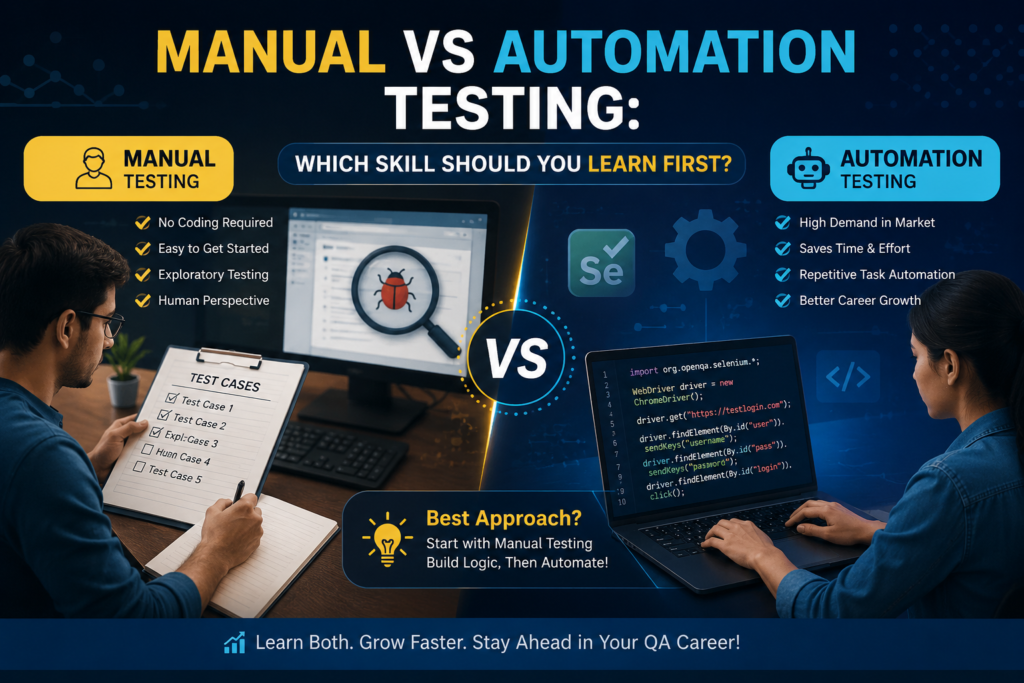
Manual testing is exactly what it sounds like: a tester works through an application by hand, following test cases, exploring edge cases, and logging bugs without writing code. It relies on attention to detail, business understanding and structured thinking rather than programming. Manual testing is almost always the entry point into a QA career, because it teaches you how software actually breaks before you try to automate the process of finding those breaks.
What Is Automation Testing?
Automation testing uses scripts and tools Selenium, Cypress, Playwright and similar frameworks to run repetitive test cases automatically, without a human clicking through the same screens every release. It requires programming knowledge, usually in Java, Python or JavaScript, plus an understanding of test frameworks and CI/CD pipelines. If you already have some coding background, our automation testing with Selenium course page covers the full curriculum and tools used.
Manual vs Automation Testing: Side-by-Side Comparison
| Factor | Manual Testing | Automation Testing |
|---|---|---|
| Core skill | Attention to detail, exploratory thinking, business/domain knowledge | Programming (Java/Python), test frameworks, CI/CD tools |
| Learning curve | Faster to pick up — no coding required | Steeper — needs coding fundamentals first |
| Typical tools | Test cases, checklists, Jira, TestRail | Selenium, Cypress, Playwright, Postman, Jenkins |
| Best first job | Junior/graduate QA tester | SDET, automation engineer (usually after manual experience) |
| Career ceiling | QA Lead, Test Manager | SDET, Automation Architect, DevOps-adjacent roles |
| Typical starting salary (AU) | Entry-level, city dependent | Higher than manual-only, city dependent |
Manual vs Automation Testing: Which Should You Learn First?
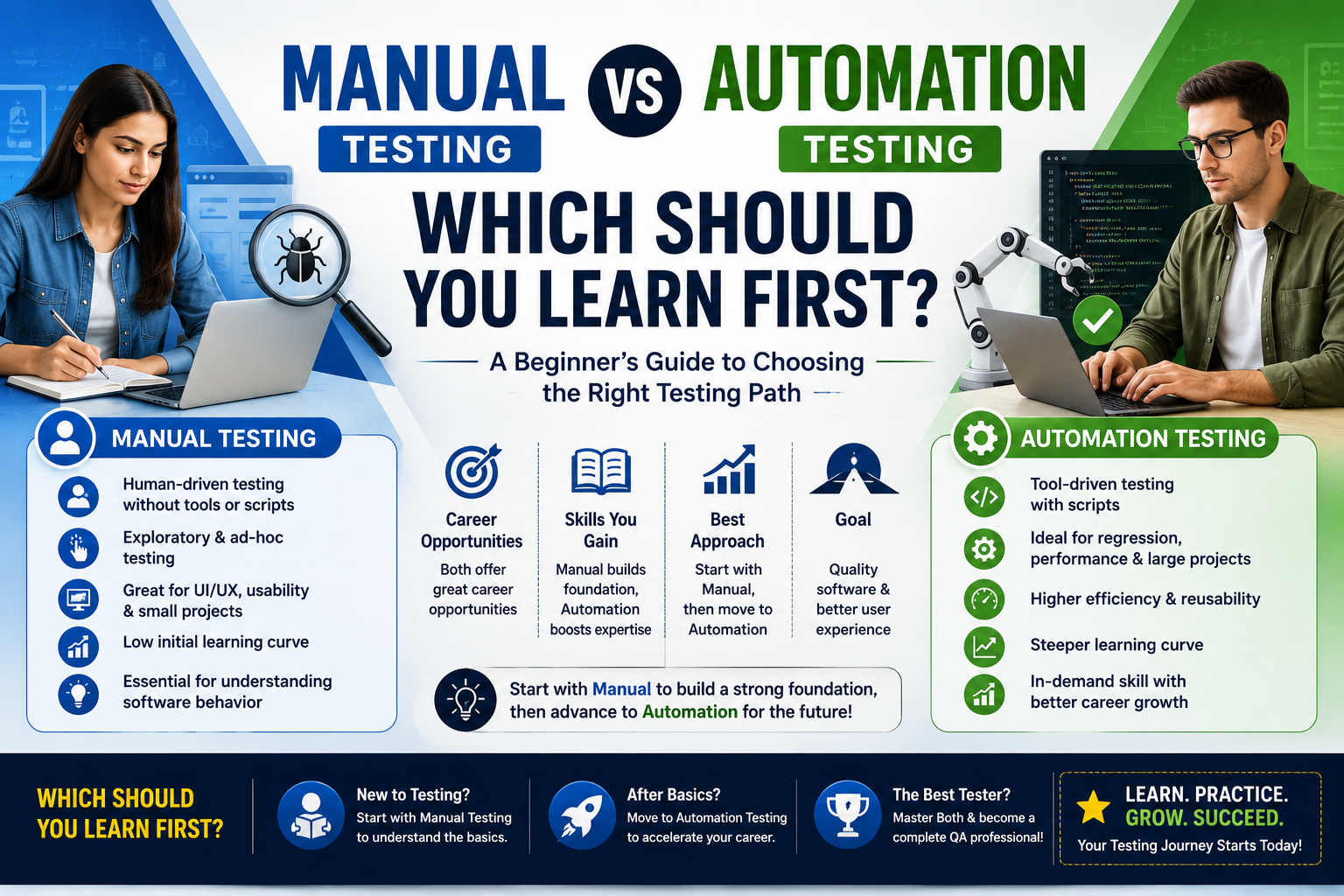
For most beginners, the honest answer to the manual vs automation testing question is: start with manual. It has a shorter learning curve, doesn’t require coding, and builds the domain knowledge that makes you a far better automation engineer later on. Almost every experienced automation tester started out writing manual test cases first. If you’re completely new to IT, our manual testing course is designed as that first step, with no prior programming experience assumed.
When It Makes Sense to Learn Automation First
- You already have a programming background (even basic Java, Python or JavaScript).
- You’re transitioning from a developer role into QA or SDET work.
- Your target employer specifically lists automation tools as a must-have in job ads.
- You want to move into DevOps-adjacent roles where automated testing is part of the pipeline.
Career Paths and Salary Expectations in Australia
Both manual and automation testers are in steady demand across Australia’s major tech hubs Sydney, Melbourne, Brisbane, Perth, Adelaide and Canberra with government, finance and enterprise software teams all hiring QA staff year-round. Automation skills typically command a salary premium over manual-only roles, but manual testing remains the more accessible entry point. For a full breakdown of what testers earn city by city, see our software tester salaries in Australia guide.
A Realistic Learning Path: Manual to Automation
- Step 1 — Learn manual testing fundamentals: test case design, bug reporting, the software testing life cycle.
- Step 2 — Get comfortable with SQL and basic scripting to strengthen your technical foundation.
- Step 3 — Learn a programming language (Java or Python are the most common choices for automation).
- Step 4 — Move into automation tools like Selenium, Cypress or Playwright once the fundamentals are solid.
Where to Train in Software Testing
Logitrain runs instructor-led manual and automation testing courses across Australia’s major cities, as well as live online delivery for regional students. You can see current course dates and delivery formats through Logitrain’s instructor-led IT courses. Whichever path you choose first, enrolling in a structured software testing course will get you job-ready faster than self-study alone.
Official Testing Standards Resource
For internationally recognised testing standards and certification syllabi, ISTQB maintains detailed guidance at istqb.org, which is a useful reference alongside any structured course.
Final Thoughts
The manual vs automation testing decision doesn’t have to be either/or most successful QA careers involve both, just in a particular order. Start with manual testing to build your foundation, then layer automation skills on top once you’re comfortable with the fundamentals. That sequence gives you the strongest, most employable skill set for Australia’s software testing job market in 2026.