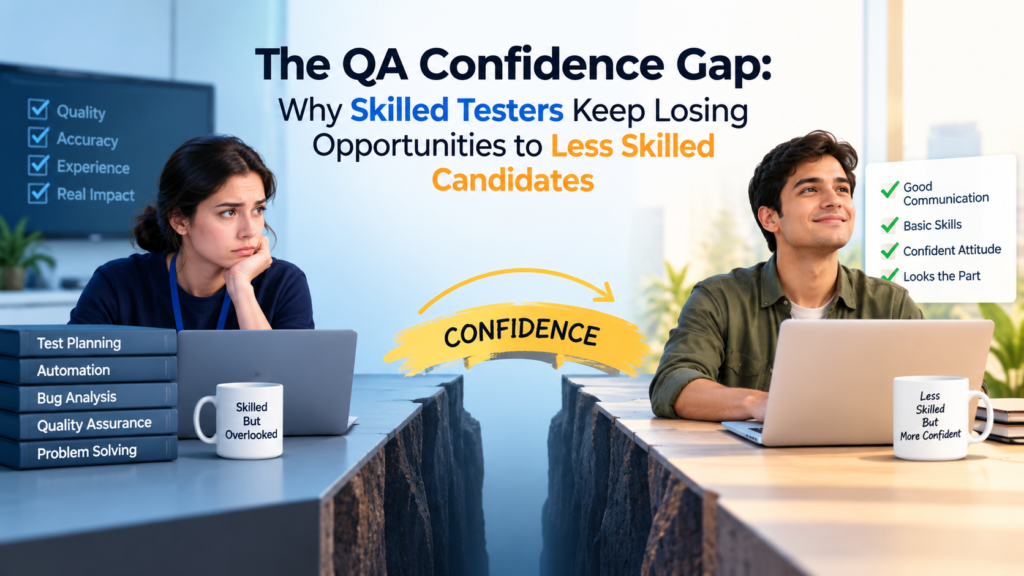
If you’ve spent years mastering test cases, automation frameworks and bug triage, only to watch a candidate with half your experience walk away with the offer, you’re not imagining things. It’s a pattern known as the QA confidence gap the space between what a tester actually knows and how convincingly they present that knowledge under interview pressure. Technical skill gets you shortlisted. Confidence gets you hired. And in a crowded software testing job market, that gap is quietly costing skilled testers real opportunities.
This isn’t a motivational pep talk. It’s a practical look at why the QA confidence gap exists, how it shows up in interviews and daily work, and the concrete steps that help experienced testers finally get recognised for what they can do.
What Is the QA Confidence Gap, Exactly?
The QA confidence gap describes the mismatch between a tester’s real ability and how well they communicate that ability to hiring managers, team leads and stakeholders. Two candidates can have identical resumes on paper. One explains their testing approach with hesitation, over-qualifies every answer with “I think” or “maybe,” and downplays their own contributions. The other, with noticeably less hands-on experience, speaks in a structured, assured way about test strategy, defect impact and business risk even if the underlying knowledge is thinner.
Recruiters and panel interviewers are human. In the absence of a live coding test or a hands-on defect triage exercise, they default to reading confidence as competence. That single bias is enough to tip an offer toward the less-skilled but more assured candidate.
Why Technical Skill Alone Isn’t Enough to Win the Job
Software testing rewards precision, caution and scepticism the exact traits that make a great tester can also make someone a hesitant interviewee. Testers are trained to question assumptions, flag edge cases and avoid overstating results. That instinct is brilliant in a test report and a liability in a 45-minute interview, where certainty reads as capability.
- Interviewers rarely see your actual test artefacts, so they judge you on how you narrate your work.
- Behavioural and STAR-style questions reward storytelling structure, not just technical accuracy.
- Salary negotiations and role scoping almost always favour the candidate who sounds sure of their own value.
- Internal promotions often go to testers who are visible and vocal, not just accurate and thorough.
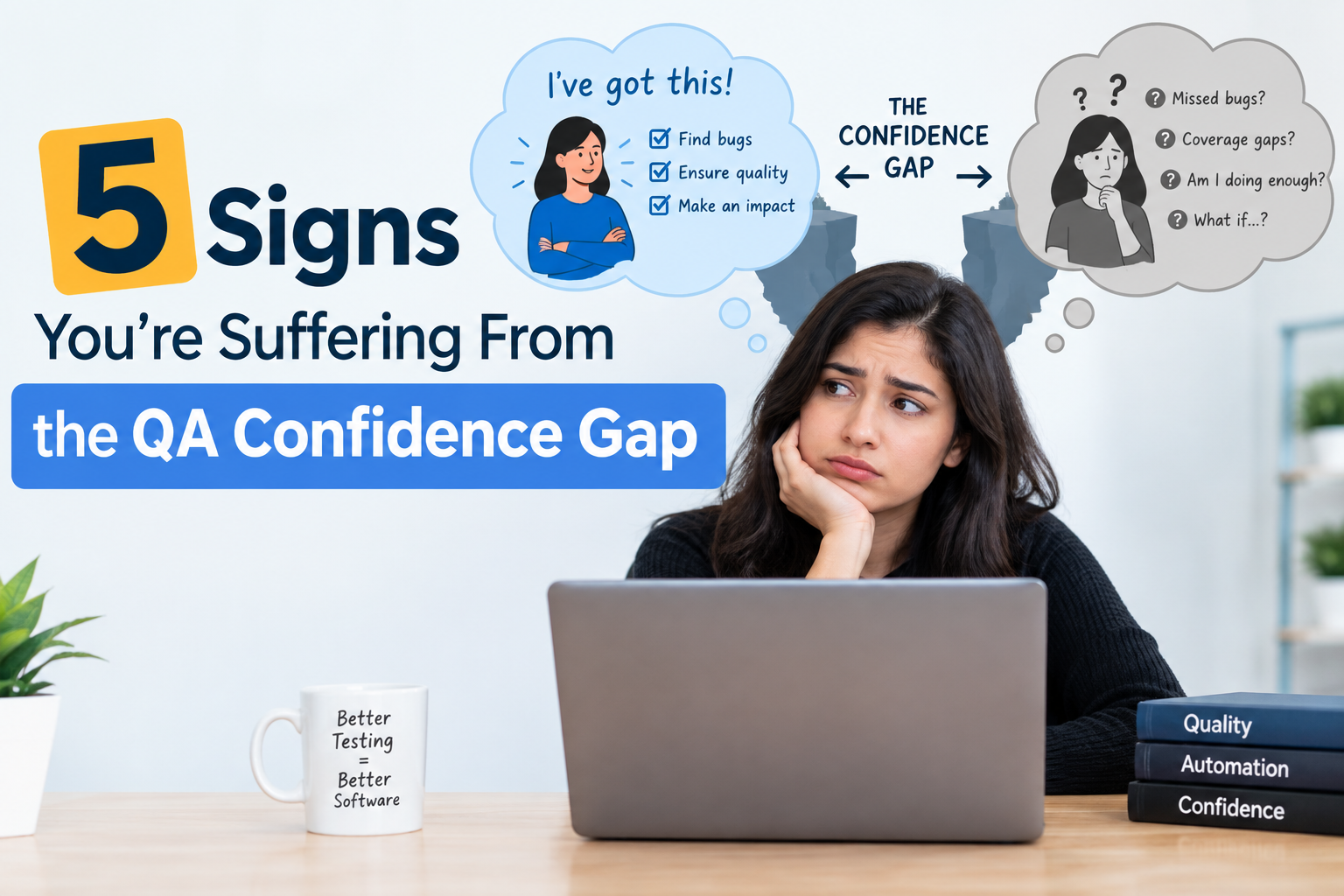
5 Signs You’re Suffering From the QA Confidence Gap
1. You under-explain strong work
You ship solid regression suites and catch critical defects, but when asked to describe your process, you compress months of work into two flat sentences.
2. You over-qualify every answer
“I’m not 100% sure, but I think it might be…” is a habit that quietly erodes an interviewer’s confidence in you, even when the answer is correct.
3. You avoid claiming credit
You say “the team found the bug” when you were the one who isolated the root cause, wrote the reproduction steps and flagged the severity.
4. You freeze on open-ended questions
Questions like “walk me through how you’d test this login flow” catch you off guard, even though you do exactly this every day on the job.
5. You compare yourself to louder colleagues
You’ve watched a less experienced tester get promoted or hired ahead of you and quietly assumed it was purely about skill when interview presence played a much bigger role.
How Less Skilled Candidates Outperform You in Interviews
It’s rarely dishonesty. Less experienced candidates who land the job usually do a few specific things well:
- They practise answers out loud before the interview, so the delivery feels natural rather than rehearsed.
- They use frameworks like STAR (Situation, Task, Action, Result) to structure every answer, even thin ones.
- They quantify impact “reduced regression time by 30%” even with modest projects, because numbers sound credible.
- They ask sharp questions back, which signals engagement and seniority regardless of actual experience.
- They treat the interview as a performance to prepare for, not a technical exam to pass or fail.
How to Close the QA Confidence Gap
Closing the gap doesn’t mean inflating your skills. It means presenting your real, hard-earned experience in a way that matches its actual value.
Build a “proof bank” of your best work
Keep a running list of specific bugs you caught, test strategies you designed, and measurable outcomes release delays avoided, defect leakage reduced, automation coverage improved. Pull from this list in every interview instead of improvising.
Rehearse answers to the questions you always freeze on
Write out answers to the five or six questions that trip you up most, then say them aloud until they sound conversational rather than memorised.
Practise mock interviews and live testing scenarios
Structured mock interviews and hands-on scenario practice the kind covered in a dedicated software testing course train you to think out loud under pressure, the exact skill that separates confident testers from silent ones.
Get comfortable talking about business impact, not just bugs
Stakeholders and hiring managers respond to risk and cost. Reframe your work: instead of “I found a bug in checkout,” say “I identified a payment failure that would have affected every customer at checkout before release.”
Seek feedback from a mentor or community, not just your resume
A resume shows what you did. A mentor or peer group can tell you how you sound when you talk about it and that feedback loop is where real interview confidence is built.
Build Confidence Through Structured, Job-Ready Training
The fastest way to close the QA confidence gap is deliberate practice inside a real curriculum live projects, mock interviews and feedback from working QA professionals, not just self-study. That’s the gap a good software testing course is designed to close.
Testers across Australia are already using structured, instructor-led training to turn technical skill into interview-ready confidence, including learners based in:
- Sydney full-time and part-time manual and automation testing pathways
- Melbourne evening and weekend classes built for career switchers
- Brisbane beginner-friendly QA fundamentals through to automation
- Perth flexible online delivery for working professionals
- Adelaide mentor-led mock interviews and resume support
- Canberra government and enterprise-focused testing tracks
Explore the full course catalogue and upcoming intakes at softwaretestingcourse.au.
Further Reading and Trusted Resources
For readers who want to go deeper on testing standards and career development, these external resources are worth bookmarking:
- ISTQB the global standard for software testing certification and syllabi.
- Indeed Career Guide practical interview preparation and career advice.
- Harvard Business Reviewresearch-backed articles on workplace confidence and communication.
Final Thoughts: Skill Gets You Noticed, Confidence Gets You Hired
The QA confidence gap isn’t a character flaw it’s a byproduct of a profession that trains people to be careful, precise and modest about their own work. But hiring decisions are made in minutes, not months, and the tester who can clearly narrate their value will keep beating the tester who simply hopes their resume speaks for itself.