


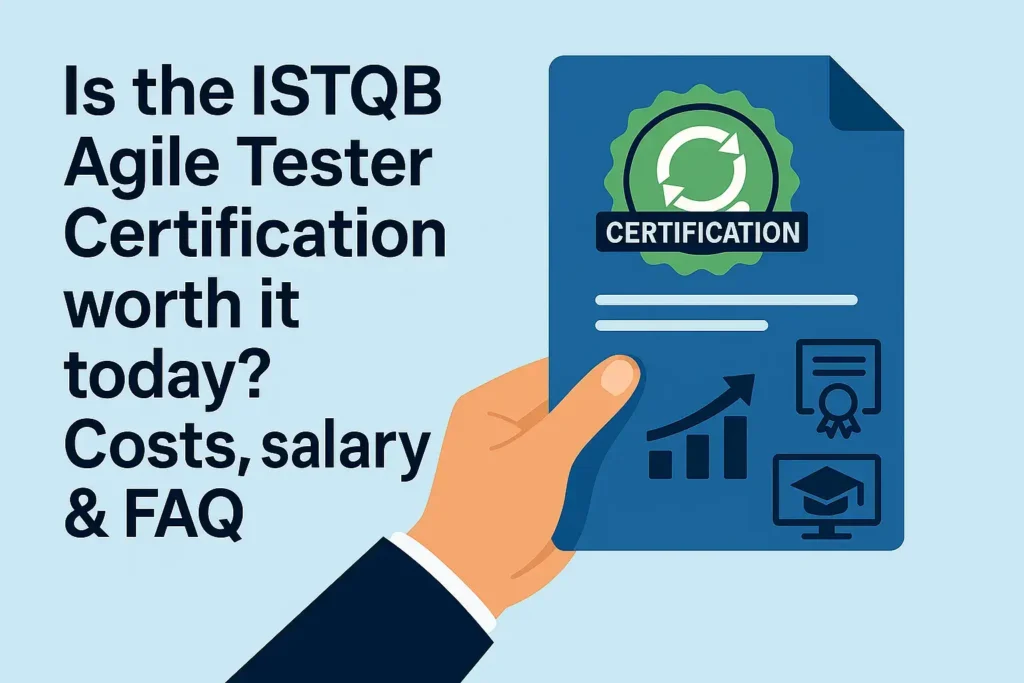
What is the ISTQB Agile Tester Course Certification?
The ISTQB® Certified Tester Foundation Level – Agile Tester (CTFL‑AT) validates the skills needed to contribute effectively to an Agile project. It aligns agile testing with the Agile Manifesto principles and emphasises the whole‑team approach with developers and business representatives.
Entry requirement: To sit CTFL‑AT you must hold the ISTQB Certified Tester Foundation Level (CTFL) certificate (version 4.0 or earlier). Because CTFL v4.0 already covers agile-related content, CTFL‑AT is usually not necessary if you are already CTFL v4 certified.
Exam structure: 40 multiple‑choice questions, 60 minutes, pass mark 65% (26/40). Non-native language candidates may apply for a 25% time extension.
Syllabus focus areas: Agile fundamentals and approaches, agile testing principles and practices, how testing differs in agile vs. traditional contexts, tester roles and skills in agile teams, agile testing methods and tools, quality risk in agile, estimating test effort, and techniques used in agile projects.
Why is the ISTQB Agile Tester Course Certification so popular?
- Global recognition: ISTQB is the world’s leading testing certification scheme, with 1.4 million exams administered and over 1 million certifications in 130+ countries. CTFL‑AT sits within this globally accepted portfolio.
- Clear pathway: ISTQB maps a progression from CTFL through Agile Tester and onwards to Advanced Agile Technical Tester (CTAL‑ATT) and other Specialist/Advanced modules—helpful for building automation and CI/CD capability.
- Exam delivery flexibility in Australia: Candidates can take the exam remotely (FLEX) or at Pearson VUE test centres nationwide.
Is the ISTQB Agile Tester Certification worth it today?
If you operate in agile environments—or want to formalise your agile testing capability—the certification remains relevant and worthwhile:
- It proves you can apply agile testing principles and techniques and collaborate effectively across a whole‑team delivery model.
- It complements CTFL v4.0 by deepening agile-specific practices.
- It connects you to a recognised global scheme with an established Successful Candidate Register (SCR)—useful for verification during hiring.
Pros of ISTQB Agile Tester Certification
- Job availability: Agile delivery is ubiquitous. CTFL‑AT demonstrates how testing works in scrum/iterative teams, how to contribute to planning and test-related activities, and how to support automation in agile contexts—competencies employers seek.
- ISTQB Agile Tester salary potential: CTFL‑AT offers independent validation of agile testing skills and a pathway to Advanced Agile Technical Tester (CTAL‑ATT), supporting progression to higher-responsibility roles.
- Global recognition: ISTQB certifications are internationally recognised and portable across countries.
- Career pathways: After CTFL‑AT you can pursue CTAL‑ATT to deepen technical skills in agile (automation, CI/CD, service virtualisation), or branch into Advanced/Test Management and Specialist modules—progressing from tester to SDET or QE roles.
Cons of ISTQB Agile Tester Certification
- Cost considerations (Australia): Fees vary by provider and delivery mode (remote proctor vs Pearson VUE). Pricing appears in AUD during booking.
- Evolving industry demands: Agile teams increasingly expect skills in automation and CI/CD. CTFL‑AT validates agile testing principles; further advancement into CTAL‑ATT is recommended for technical practices.
- Certification difficulty: Entry-level but time-boxed (60 minutes). Questions span agile fundamentals, practices, and application.
Where to begin to get your ISTQB Agile Tester Certification
- Confirm the prerequisite: Hold CTFL (v4.0 or earlier). Review potential overlap with CTFL‑AT if already certified.
- Download the syllabus & exam rules: Understand business outcomes, learning objectives, exam structure (40 questions / 60 minutes / 65% pass), and non-native time extension options.
- Choose your training path: Attend an accredited training provider (classroom, virtual, e-learning) or self-study using the official syllabus.
- Book the exam in Australia: Decide between FLEX remote or Pearson VUE centre. Fees appear in AUD during booking.
Key topics covered in the ISTQB Agile Tester Course
- Agile software development fundamentals and agile approaches.
- Agile testing principles, practices and processes; the role and skills of a tester in an agile team.
- Differences between agile and traditional testing; status of testing on agile projects.
- Agile test methods, techniques & tools; quality risk and test-effort estimation in agile.
Is an ISTQB Agile Tester certificate enough to get a job?
It signals that you understand agile testing basics and can contribute within a scrum team. Many employers want CTFL plus CTFL‑AT for junior QA roles, combined with real project experience in automation and CI/CD.
Is ISTQB Agile Tester worth it in Australia?
Yes. The scheme is globally recognised, bookings are straightforward, and the exam can be taken online or at a Pearson VUE centre. CTFL‑AT complements agile delivery effectively.
Does having an ISTQB Agile Tester Certification pay well?
Official salaries are not published. The certification verifies agile testing competence and provides a clear path to advanced technical certifications, which typically correlate with increased responsibility and pay over time.
Is the ISTQB Agile Tester exam very difficult?
It is manageable with preparation. The exam scope is defined in the syllabus; practise applying agile testing concepts to scenarios and master the terminology. Non-native language candidates can use the 25% time extension.
Is the ISTQB Agile Tester certification stressful?
Timed exams can feel stressful. Mitigations include structured study with syllabus objectives, applying for non-native language extensions if eligible, and choosing a familiar exam format (remote or test centre).
How many fail ISTQB Agile Tester?
ISTQB does not publish pass-rate statistics. The exam has a 65% pass mark; consistent performance against syllabus objectives is the best predictor of success.
The future of software testing jobs in Australia
Agile and DevOps practices continue to shape roles. ISTQB’s portfolio (including CTFL‑AT and CTAL‑ATT) reflects this shift—emphasising whole-team quality, automation, and continuous delivery. Australian testers who invest in agile fundamentals plus technical upskilling remain well-placed for quality engineering roles across sectors.