

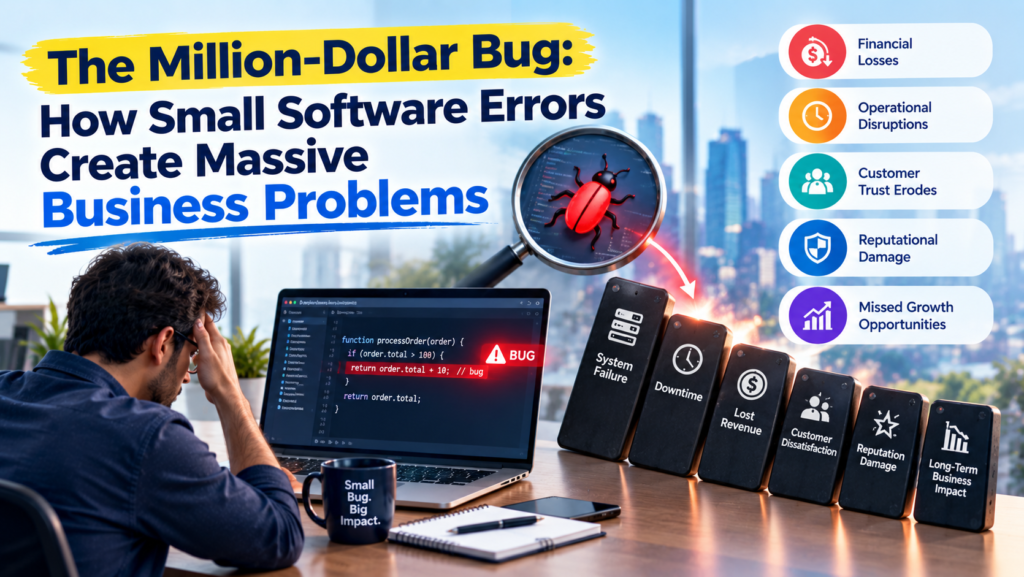
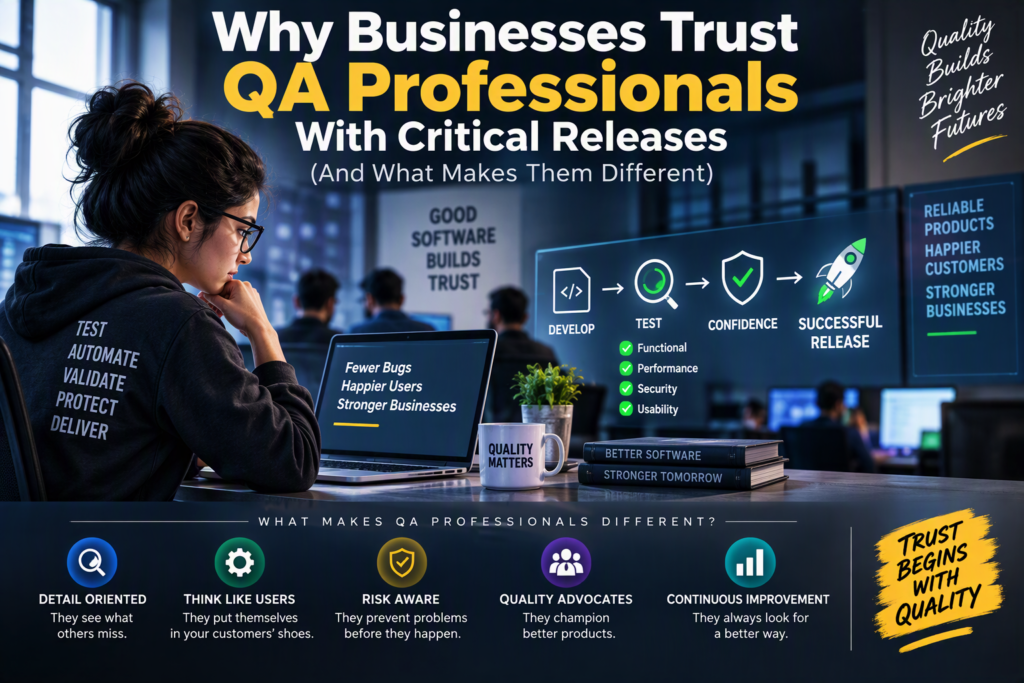

When a release goes wrong in production, it rarely stays a technical problem for long it becomes a business problem, a trust problem, and sometimes a headline. That’s precisely why QA professionals for critical releases are treated less like a checkbox on the project plan and more like a safeguard the whole business leans on. The difference between a smooth launch and a rollback at 2 a.m. usually isn’t luck. It’s who was testing, how they thought about risk, and whether they were trusted to say “not yet” when it mattered.
This article looks at why some testers earn that trust while others don’t, what specifically makes them different, and how companies across Australia are building QA teams that can be handed a critical release with confidence.
Why Businesses Trust QA Professionals With Critical Releases
Every release carries risk, but not every tester is equipped to manage it. Businesses gravitate toward the same names, teams, or partners for high-stakes deployments for a handful of consistent reasons.
They Understand the Cost of a Bad Release
Experienced testers don’t treat a missed defect as an abstract risk. They’ve seen what a failed checkout flow does to revenue, what a broken login does to support tickets, and what a data-handling bug does to compliance. That context changes how they prioritise test coverage they test what will hurt the business most if it breaks, not just what’s easiest to script.
They Think Like the End User, Not Just the Test Script
Anyone can execute a written test case. The testers businesses trust with critical releases go further: they explore the product the way a frustrated customer, a rushed employee, or a malicious actor might. This exploratory instinct catches the issues that scripted regression suites miss.
They Communicate Risk Clearly, Under Pressure
When a release date is fixed and a defect is found late, the tester’s job isn’t just to log a bug it’s to tell the business, in plain language, what the risk actually is if it ships anyway. The QA professionals companies trust most are the ones who can deliver that message calmly and factually, without either downplaying the risk or crying wolf.
What Makes These QA Professionals Different From the Rest
Trust isn’t handed out for free. It’s built through a specific set of habits and skills that separate dependable testers from the rest of the field.
A Risk-Based Testing Mindset
Instead of trying to test everything equally, they map testing effort to business impact payment flows, authentication, and data integrity get far more scrutiny than a cosmetic label change. This is a core principle taught in structured, certification-aligned training such as an ISTQB-aligned foundation course, where risk-based test planning is a core module rather than an afterthought.
Strong Manual and Automation Fundamentals
Reliable testers move comfortably between manual exploratory testing and automated regression suites. They know automation catches repeat regressions fast, but manual, human judgement is what catches the issues no script was written to expect. Building this dual skill set is exactly what a structured Selenium testing foundation certification or an intro to automation testing course is designed to develop.
Recognised Certification and Continuous Learning
Certification isn’t a formality it signals a shared, tested vocabulary and method across a QA team. Professionals holding an ISTQB Foundation (CTFL) certification, and specialised extensions like the ISTQB Agile Tester extension or the ISTQB Advanced Test Analyst (CTAL-TA) pathway, are trained against a globally recognised body of knowledge maintained by the International Software Testing Qualifications Board, not just on-the-job habits that vary from person to person.
Domain-Specific Testing Experience
A critical release in a mobile banking app, a multiplayer game, or an AI-driven feature each carries different risks. Testers who’ve trained specifically for that context through courses like mobile application testing (CT-MAT), game testing (CT-GaMe), or AI testing (CT-AI) spot domain-specific failure points generalist testers often miss.
The Skills Businesses Look For in QA Professionals for Critical Releases

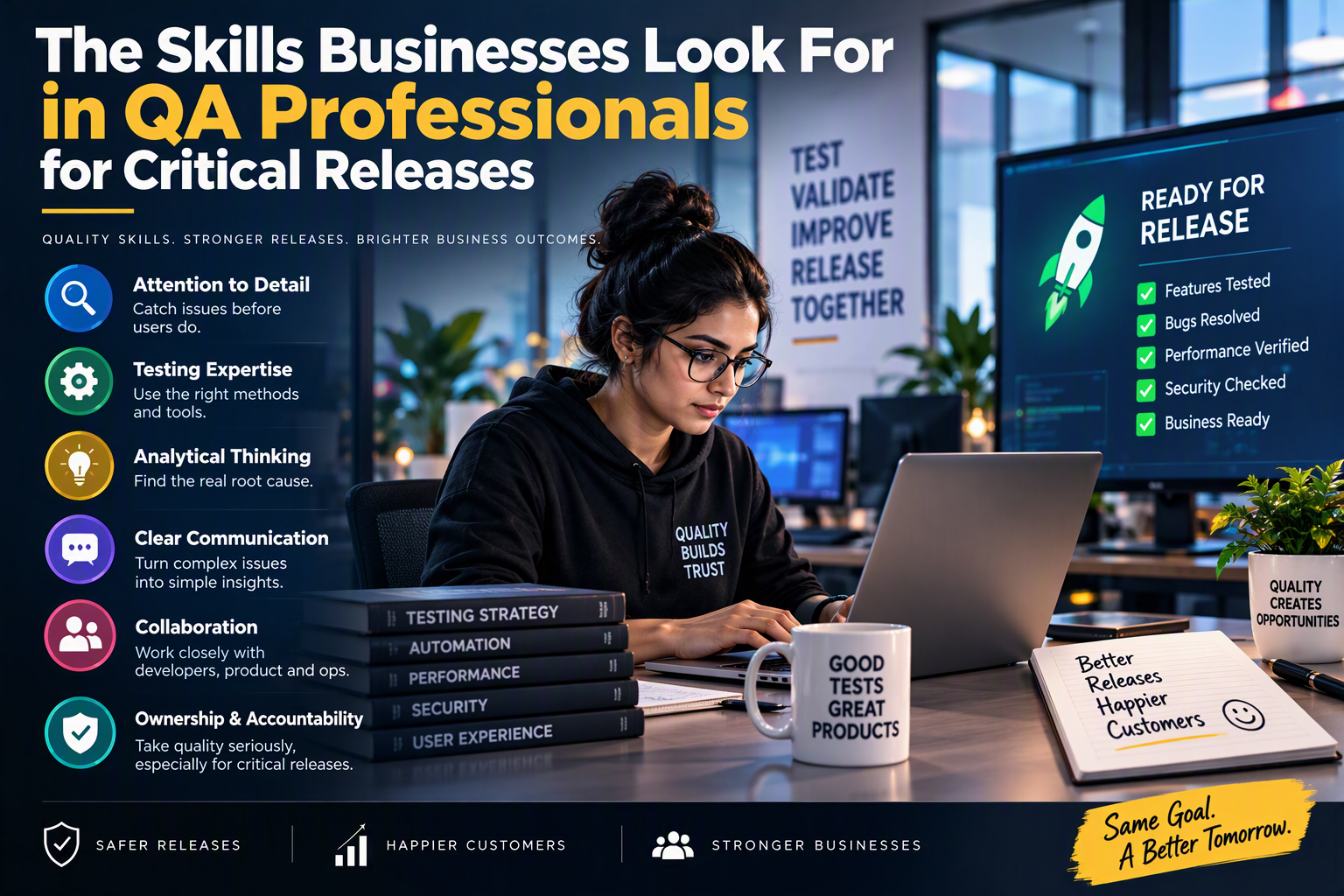
When companies vet testers or testing partners for release-critical work, a fairly consistent checklist emerges:
- Risk-based test planning and prioritisation, not just test-case execution
- Comfort with both manual exploratory testing and automation frameworks
- Working knowledge of tools such as Selenium, JIRA, TestRail, Postman, and SQL
- Recognised certification (ISTQB or equivalent) backing up practical experience
- Clear, non-technical communication when reporting risk to stakeholders
- An understanding of the software testing life cycle (STLC) and Agile delivery
- A track record of catching issues before they reach production, not just after
How Businesses Across Australia Are Building This Kind of QA Capability
This trust is being built deliberately, not left to chance. Employers across Australia’s technology sector are increasingly hiring and upskilling testers through structured, instructor-led training rather than relying on informal, self-taught QA knowledge. Programs such as the Software Testing Course are training the next generation of QA analysts, automation testers, and test analysts in exactly the practical, risk-aware skill set described above.
This training is available in several major hubs, with local, city-specific pathways as well as flexible online delivery for learners anywhere in the country:
- Software testing course in Sydney
- Software testing course in Melbourne
- Software testing course in Brisbane
- Software testing course in Perth
- Software testing course in Adelaide
- Software testing course in Canberra
Businesses in these cities are hiring locally trained testers who understand both the technical craft and the accountability that comes with being handed a critical release. For companies further along the QA maturity curve, advanced pathways such as the Agile Technical Tester (CTAL-ATT) or the Certified Tester – Model-Based Tester pathway build even deeper release-readiness capability.
What This Means If You’re Hiring or Becoming a QA Professional
If you’re a business: the testers worth trusting with critical releases are rarely the cheapest option on paper. Look for evidence of risk-based thinking, real certification, and calm, clear communication under deadline pressure not just a list of tools on a résumé.
If you’re a tester (or want to become one): the fastest way to build this kind of trust is structured, certification-backed training combined with real project practice. Explore the full range of software testing courses, read more on the Software Testing Course blog, or check the FAQs before choosing a pathway that matches your career goals.
Industry benchmarks like the ISO/IEC 25010 quality model and public engineering write-ups such as the Google Testing Blog are also useful, ongoing reading for anyone who wants to keep their testing judgement sharp beyond a single course.
Final Word
Businesses don’t hand critical releases to just anyone. They hand them to QA professionals for critical releases professionals who’ve proven, through certification, communication, and judgement under pressure, that they can be trusted with the moment a release either succeeds quietly or fails loudly. Building or hiring that capability starts with the right training.
Ready to build that capability? Speak to a course advisor or explore courses now.