
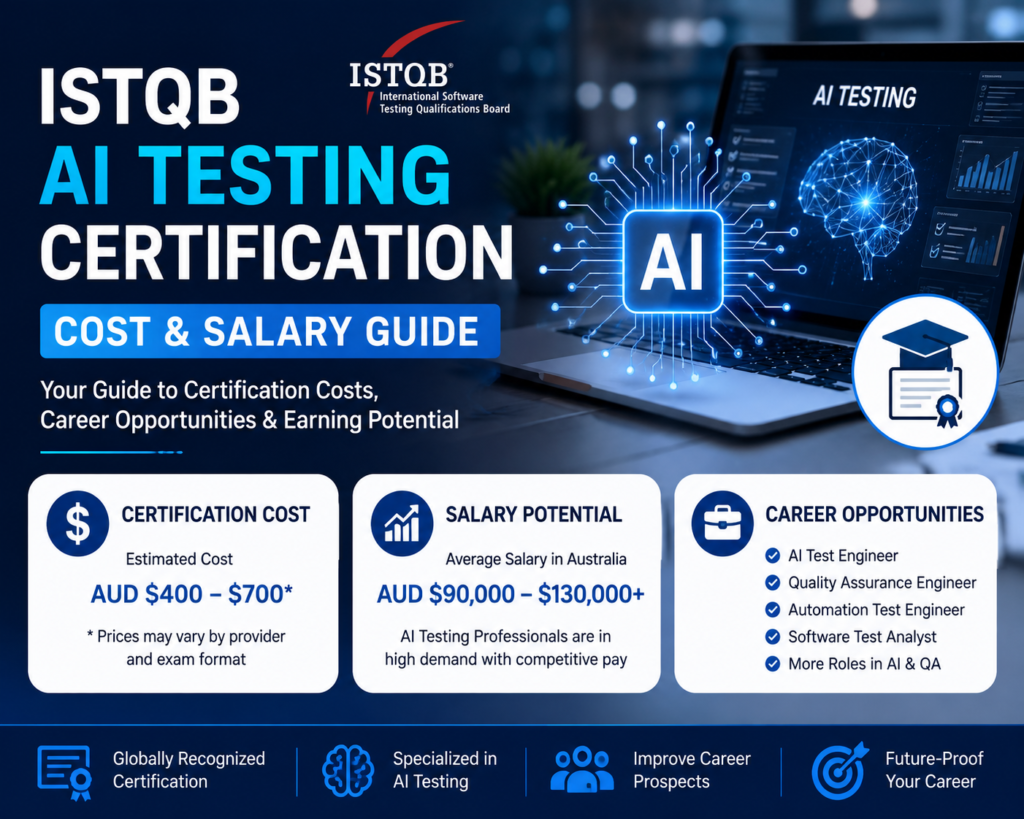
If you’re deciding whether the ISTQB CT-AI certification is worth the time and cost, you’re asking at exactly the right moment AI-based systems are now embedded in mainstream software, and testing them properly requires skills most traditional QA training never covered. This guide breaks down what CT-AI actually teaches, what changed between v1.0 and the new v2.0 syllabus, what it costs, how it affects salary and job prospects in Australia, and who genuinely benefits from getting certified in 2026.
What Is the ISTQB CT-AI Certification?
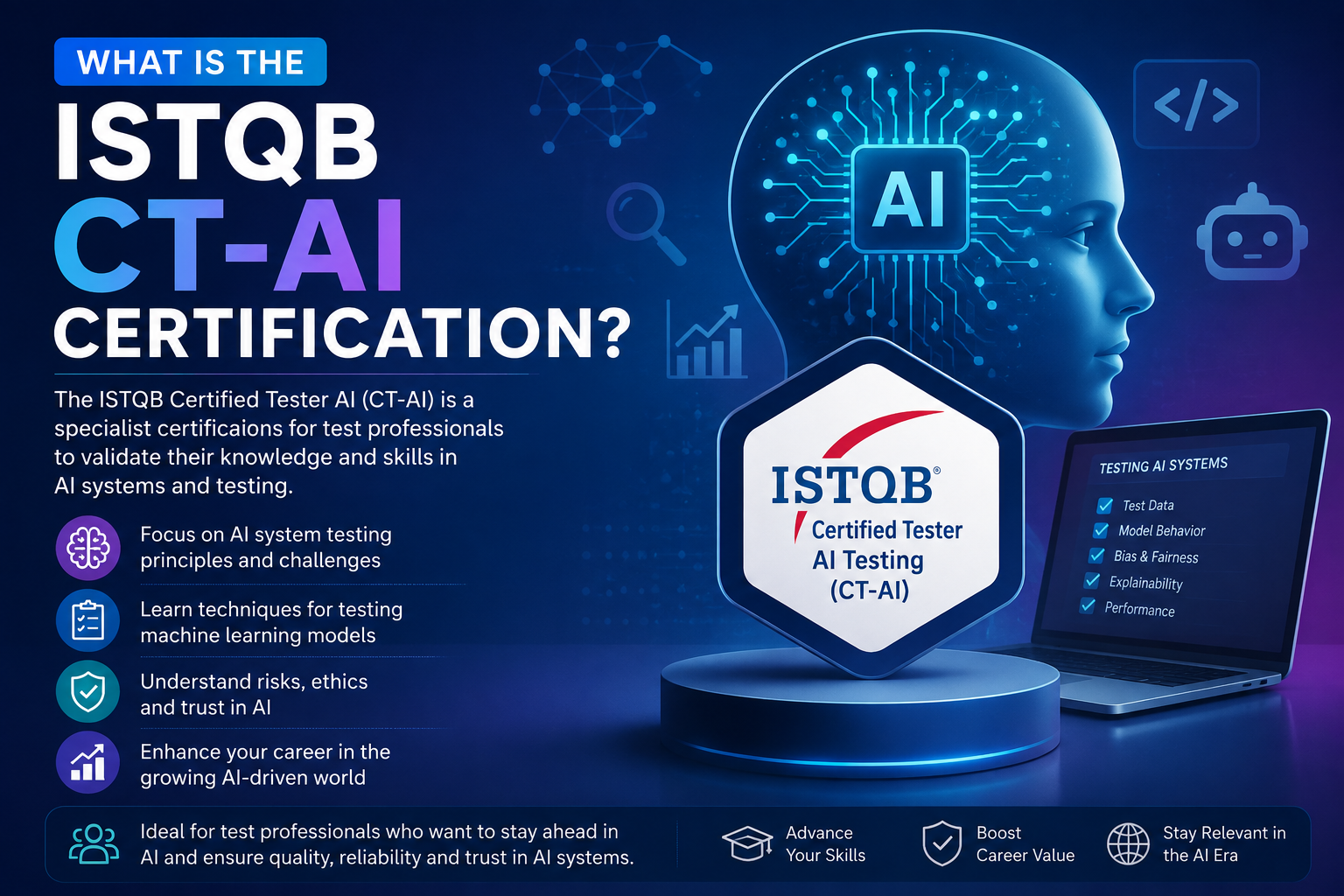
ISTQB Certified Tester AI Testing (CT-AI) is a specialist certification from the International Software Testing Qualifications Board focused on testing AI-based systems, including machine learning models and generative AI systems such as large language models. It covers the current state of AI, how machine learning models are built and tested, the specific quality characteristics unique to AI systems (like bias, non-determinism, transparency and explainability), and how to design and execute test cases for AI-based systems specifically not general software testing applied loosely to an AI product.
CT-AI v1.0 vs v2.0: Which Should You Take in 2026?
This matters more than most candidates realise. ISTQB released CT-AI v2.0 in 2026, restructuring the syllabus around data, machine learning models and system-level testing, with a stronger practical focus on how AI systems are actually tested in real environments. The older v1.0 certification is being retired the English-language exam stays available until April 21, 2027, non-English versions until October 21, 2027, after which v1.0 exams and training will no longer run. If you’re starting fresh in 2026, prepare for v2.0. There’s little upside to studying the outgoing syllabus when the current version better reflects how AI testing is actually practised today.
Prerequisites and Exam Format
The ISTQB Certified Tester Foundation Level (CTFL) certification is a prerequisite for CT-AI — you can’t sit this exam as your first ISTQB qualification. Once you’re eligible, the CT-AI exam consists of 40 multiple-choice questions worth 47 total points, and you need at least 65% (31 points) to pass. The exam runs for 60 minutes, extended to 75 minutes if the exam language isn’t your native language. If you haven’t completed your ISTQB Foundation (CTFL) course yet, that’s the logical starting point before CT-AI.
ISTQB CT-AI Certification Cost in Australia
Pricing varies by training provider, delivery format, and whether the exam voucher is bundled with the course. Rather than quoting a fixed figure that could be outdated, check current pricing directly with your training provider, since specialist ISTQB certifications like CT-AI are priced differently to the Foundation level and can shift as v2.0 training rolls out more widely across Australia.
Is ISTQB CT-AI Certification Worth It in Australia in 2026?
For testers, test analysts and QA engineers who are already working with or expect to work with AI-based systems, yes CT-AI fills a genuine skills gap. Traditional test case design doesn’t map cleanly onto probabilistic, non-deterministic AI behaviour, and CT-AI is one of the few vendor-neutral, internationally recognised certifications built specifically to address that. It’s a weaker case if your organisation has no current or near-term AI testing work, since CT-AI is a specialist credential rather than a general-purpose one — in that scenario, strengthening your Foundation-level or automation testing skills first will likely serve you better.
CT-AI Salary Impact in Australia
CT-AI won’t single-handedly change your salary, but it does two practical things: it differentiates your profile in a market where most testers still don’t hold an AI-specific qualification, and it opens the door to roles explicitly involving AI system validation, which tend to sit at a premium compared to general manual testing roles. According to Jobs and Skills Australia, software testing remains a steady, full-time occupation nationally, and specialist skills layered on top of core testing experience like AI testing capability are exactly what separates candidates competing for the same roles.
AI Testing Careers by Australian City
AI-adjacent testing roles are emerging across every major Australian tech hub. Sydney and Melbourne have the deepest concentration of AI and machine learning teams needing dedicated testing support. Brisbane and Perth are seeing growing demand as government and resources-sector organisations adopt AI-driven tools. Adelaide and Canberra have steady opportunities tied to defence and public-sector AI governance and assurance work, where structured, certified AI testing knowledge is increasingly expected rather than optional.
Who Should Get CT-AI Certified?
- Testers and QA engineers whose organisation is building or integrating AI-based features
- Test analysts and test managers responsible for defining test strategy on ML or generative AI projects
- Data analysts and developers who need a structured understanding of AI quality characteristics
- Experienced testers looking to specialise and differentiate themselves in a crowded QA job market
It’s less relevant for absolute beginners CT-AI assumes you already hold CTFL and understand core testing concepts, so it’s a specialisation layered onto existing testing knowledge, not a starting point.
How CT-AI Fits Into the ISTQB Certification Pathway
CT-AI sits at the Professional level of the ISTQB scheme, alongside other specialist certifications. Most candidates start with ISTQB Foundation (CTFL), build practical experience, then choose a specialisation that matches their career direction — CT-AI for AI-based systems, or other Professional-level paths like ISTQB Advanced Test Analyst (CTAL-TA) for deeper test analysis skills. Because ISTQB certifications are internationally recognised and vendor-neutral, they combine well many testers hold CTFL plus two or three specialist certifications relevant to their actual day-to-day work.
How to Get CT-AI Certified in Australia
The ISTQB Certified Tester – AI Testing (CT-AI) course is built around the current syllabus, combining structured lessons on AI quality characteristics with practical exercises on machine learning and generative AI testing scenarios. It’s available across major Australian cities and through live online delivery, so you can prepare for the exam without pausing full-time work.
Steps to Get CT-AI Certified
- Confirm you hold ISTQB Foundation (CTFL) — it’s a mandatory prerequisite for CT-AI.
- Enrol in a CT-AI course built around the current v2.0 syllabus, not the retiring v1.0 version.
- Work through machine learning and generative AI testing scenarios, not just theory.
- Practise with mock exams until you’re consistently scoring above the 65% pass threshold.
- Book and sit the official CT-AI exam — 40 questions, 60 minutes (75 for non-native speakers).
Not sure if CT-AI is the right next step for you? Contact the Software Testing Course team to talk through your background and career goals, or check the FAQs page for quick answers to common questions.
Frequently Asked Questions
Is ISTQB CT-AI certification worth it if I’m not working on AI projects yet?
It can still be worth it as a forward-looking investment, since AI-based systems are increasingly common across industries. If AI testing work isn’t imminent for you, though, strengthening your Foundation-level or automation skills first is usually the higher-priority move.
Do I need ISTQB Foundation before CT-AI?
Yes. ISTQB Certified Tester Foundation Level (CTFL) is a mandatory prerequisite for CT-AI — you can’t sit the CT-AI exam without it.
Should I study CT-AI v1.0 or v2.0 in 2026?
v2.0. It’s the current, longer-term version and better reflects how AI systems are actually tested today. v1.0 is being retired, with the English exam available only until April 21, 2027.
How hard is the CT-AI exam?
It’s a 40-question multiple-choice exam requiring at least 65% (31 of 47 points) to pass, within 60 minutes. It’s manageable with structured preparation, particularly hands-on practice with machine learning and generative AI testing scenarios rather than theory alone.
Does CT-AI certification guarantee a salary increase in Australia?
Not by itself, but it differentiates your profile for AI-specific testing roles, which often carry a premium over general manual testing positions, particularly in organisations actively building or integrating AI features.