

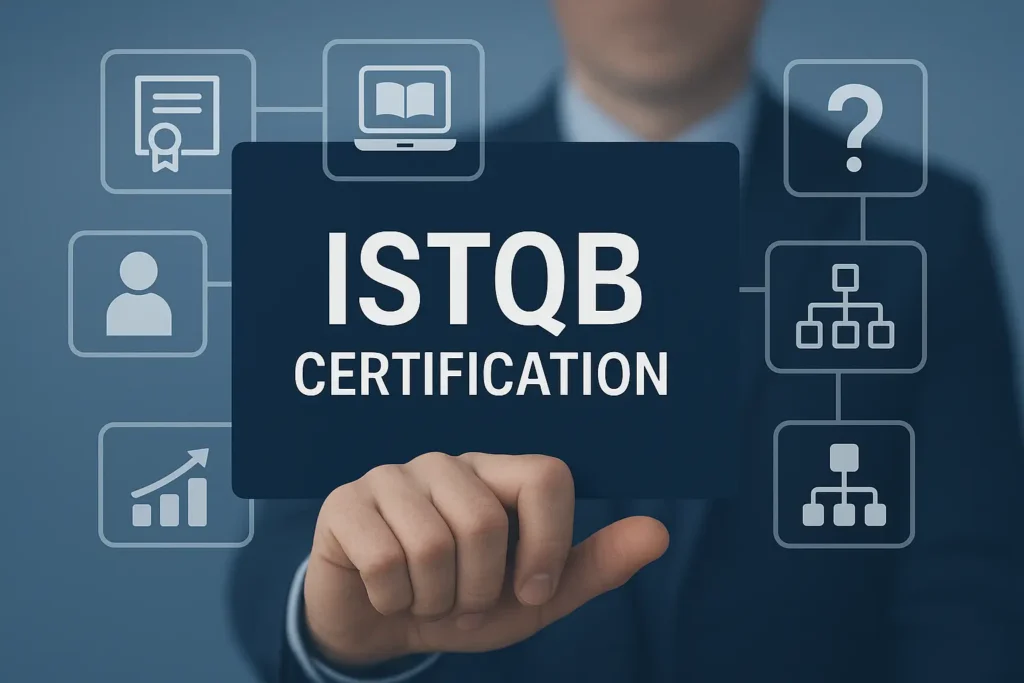
What is the ISTQB Foundation Certification?
The International Software Testing Qualifications Board (ISTQB®) Certified Tester Foundation Level (CTFL) is the entry point to the ISTQB certification scheme. It validates a practical understanding of fundamental software testing concepts, terminology and techniques that apply across development approaches including Waterfall, Agile, DevOps and Continuous Delivery. CTFL is also the prerequisite for progressing to Advanced, Specialist and Expert level ISTQB certifications.
The official CTFL v4.0 exam structure is: 40 multiple‑choice questions, 60 minutes duration, and a pass mark of 65% (26/40). Candidates taking the exam in a language that is not their native language may apply for a 25% time extension.
Certificates issued by ISTQB have lifelong validity; there is no mandatory re‑certification when new syllabus versions are released.
Why is the ISTQB Foundation Certification so popular?
ISTQB is a global, vendor‑neutral scheme with Member Boards and Accredited Training Providers around the world. As of May 2025, ISTQB reports 1.4 million exams administered and over 1 million certifications issued across 130+ countries, underscoring its worldwide recognition.
In Australia, the Australia & New Zealand Testing Board (ANZTB) represents ISTQB locally and facilitates certification and accredited training through exam partners and training providers.
Is the ISTQB Foundation Certification worth it today?
If you’re entering or formalising a role in testing or quality engineering, CTFL remains relevant and widely recognised. The v4.0 syllabus was comprehensively updated to reflect modern practices and the “whole‑team approach” to quality, blending concepts from traditional and agile lifecycles.
Who benefits? Testers, test analysts, user acceptance testers, developers, BAs and delivery leaders who need a shared language and consistent testing techniques.
Pros of ISTQB Foundation Certification
Job availability
Employers globally use ISTQB as a benchmark to validate fundamental testing knowledge. It standardises terminology (via the ISTQB Glossary) and gives hiring teams confidence in a candidate’s baseline competencies.
ISTQB Foundation salary potential
ISTQB does not publish salary figures. However, the Foundation credential provides independent, internationally recognised validation of skills and supports career progression into higher‑level certifications (Advanced, Specialist, Expert), which can expand your scope and responsibility.
Global recognition
The scheme’s consistent processes across Member Boards make ISTQB certifications portable worldwide. Australian professionals certify locally via ANZTB while benefiting from global recognition.
Career pathways
CTFL is the prerequisite to Advanced modules such as Test Analyst, Technical Test Analyst, Test Manager, and Specialist areas like AI Testing, Performance Testing, Usability, Mobile and Agile Technical Tester, among others.
Cons of ISTQB Foundation Certification
Cost considerations (ISTQB exam fee in Australia)
Fees are set by exam providers and vary by region and delivery method (remote proctored vs. test centre). In Australia, ANZTB directs candidates to its exam partner to book and see prices in AUD at checkout. If purchasing via the US Member Board (AT*SQA/ASTQB), the CTFL exam fee is US$229 (for reference), with local Australian pricing differing based on provider and currency.
Evolving industry demands
Testing roles increasingly integrate with development and DevOps, emphasising collaboration, risk‑based thinking and automation. The CTFL v4.0 update aligns to these demands, but you may still need additional skills (e.g., test automation) through higher‑level ISTQB certifications.
Certification difficulty
CTFL is entry‑level, but not trivial. You’ll need to understand the syllabus content and apply techniques to scenario‑based questions within tight time limits. Training is recommended (not mandatory), and official sample exams are available.
Where to begin to get your ISTQB Foundation Certification
- Review the official CTFL syllabus (v4.0.1) and business outcomes to understand scope and depth.
- Use official sample exams to practise timing and question styles.
- Choose your prep path: self‑study from the syllabus and glossary, or attend an accredited training course (classroom, virtual or e‑learning).
- Book your exam through the Australian channel (ANZTB → exam partner) to select remote proctored or Pearson VUE test centre delivery and see AUD pricing.
(If you’re planning training with Logitrain, we can align the schedule and delivery to your timeline and exam date.)
Key topics covered in ISTQB Foundation (CTFL v4.0)
- Fundamentals of testing (why testing is necessary, principles)
- Testing throughout the SDLC (levels, types, maintenance testing)
- Static testing (reviews and static analysis)
- Test analysis & design (black‑box/white‑box/experience‑based techniques)
- Managing test activities (planning, risk, monitoring, control, completion)
- Configuration and defect management
- Tool support for testing (including test automation benefits and risks)
Is an ISTQB Foundation certificate enough to get a job?
ISTQB provides a recognised baseline; it shows you understand test processes, terminology and design techniques. Many employers value it as part of a hiring profile, but experience, demonstrable skills (e.g., writing test cases, exploratory testing) and exposure to tools will strengthen your application. Progression to Specialist or Advanced modules can further differentiate you.
Is ISTQB Foundation worth it in Australia?
Yes—because the certification is globally portable and locally supported via ANZTB and accredited providers. You can prep with official materials and sit the exam either online with remote proctoring or at Pearson VUE centres across major cities.
Does having an ISTQB Foundation Certification pay well?
ISTQB and ANZTB do not set or publish salary bands. The certification validates your skills and can support progression to roles with higher responsibility; remuneration depends on your role, sector, location and experience. Use CTFL as a stepping stone to Advanced or Specialist areas to expand your scope and marketability.
Is the ISTQB Foundation exam very difficult?
It’s challenging but achievable with structured study. Expect scenario‑based questions that test application of techniques (e.g., boundary value analysis, decision tables) and understanding of processes. Time management matters: 40 questions in 60 minutes, 65% pass mark. Practising official sample papers helps calibrate your pace.
Is the ISTQB Foundation certification stressful?
Any timed exam can feel stressful. Practical mitigations include:
- Official mock exams to build speed and familiarity.
- Non‑native language time extension (apply via the exam provider if eligible).
- Remote proctored exam options to sit from a comfortable environment, or a local test centre if you prefer.
How many fail ISTQB?
Official pass/fail statistics are not publicly published for CTFL. The exam’s difficulty is set through ISTQB’s global exam structure and rules, and the pass mark is 65%. Your best indicator is how consistently you score on official practice sets before the exam.
The future of software testing jobs in Australia
Testing is increasingly embedded into cross‑functional teams and continuous delivery pipelines. The v4.0 syllabus refresh emphasises this whole‑team approach and addresses skills relevant to Agile and DevOps contexts—positioning CTFL as a strong foundation for modern roles. From there, Advanced and Specialist tracks (e.g., Agile Technical Testing, Test Automation Engineering, AI Testing) reflect growth areas aligned with Australian delivery practices.