

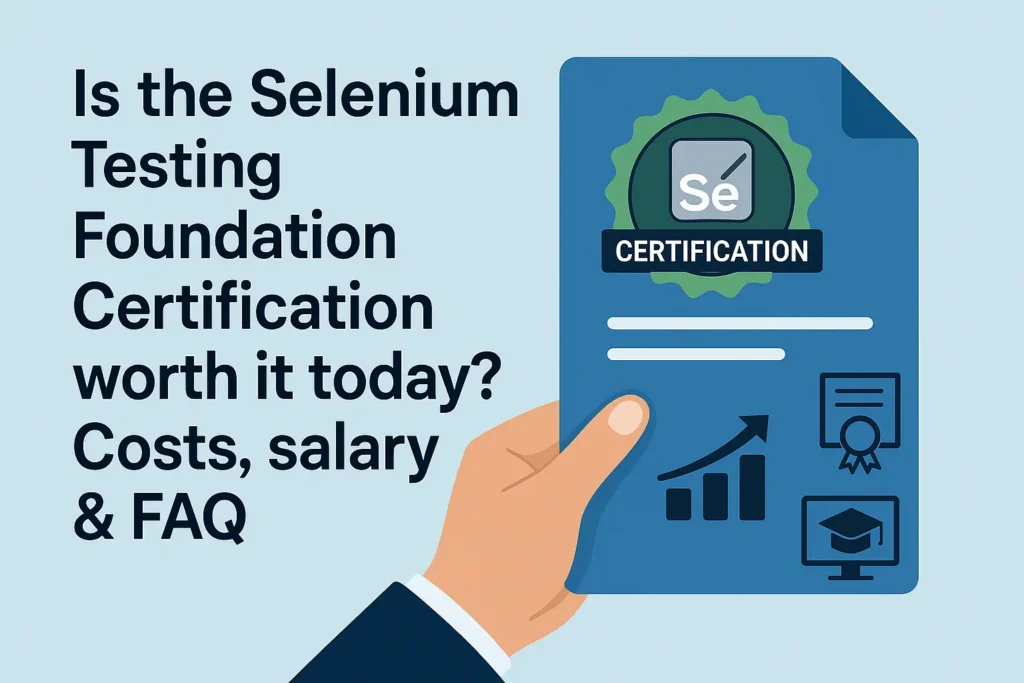
What is the Selenium Testing Foundation Certification?
The A4Q Certified Selenium 4 Tester Foundation validates practical, entry‑level knowledge of web test automation using Selenium 4 WebDriver with Python or Java as reference languages. The syllabus covers test automation principles, core web technologies (HTML, DOM, XPath, CSS), WebDriver usage, maintainable frameworks (Page Object, keyword‑driven), wait mechanisms, headless and parallel execution, and ROI‑oriented automation practices.
The official exam is multiple‑choice (40 questions), 60 minutes, with a pass mark of 65%; non‑native language candidates may apply for a 25% time extension.
Why Selenium?
Selenium is the open‑source umbrella project for browser automation (WebDriver, IDE, Grid), widely adopted for functional web testing across languages and platforms.
Why is the Selenium Testing Foundation Certification so popular?
- Widely used toolset: Selenium WebDriver is the de facto standard for browser automation, supported by major browsers and languages. A certification focused on Selenium immediately resonates with hiring teams.
- Practical, current syllabus: The latest A4Q release explicitly targets Selenium 4, blending theory with hands‑on outcomes (WebDriver interactions, maintainability patterns, parallelism, headless runs, self‑healing).
- International recognition: A4Q positions Selenium 4 Tester Foundation as a globally recognised credential; exams are available worldwide via authorised providers.
- Flexible delivery: Examinations can be sat remotely (FLEX) or at Pearson VUE test centres, giving Australian candidates convenient options.
Is the Selenium Testing Foundation Certification worth it today?
If you want a credential that proves practical automation fundamentals and you’ll be working in web application testing, it’s worth it. The syllabus ties automation design to maintainability and ROI, not just “clicking elements”—which aligns with real delivery needs.
Selenium remains highly relevant across enterprise stacks, with robust community and vendor support. Even as teams evaluate modern tools, Selenium’s ubiquity and integration ecosystem ensure continued demand—making a recognised foundation a strong investment.
Pros of Selenium Testing Foundation Certification
- Job availability: Employers consistently seek testers who can design maintainable WebDriver tests and understand XPath/CSS, waits, assertions and reporting. The A4Q syllabus drills these skills, giving recruiters confidence you meet a baseline.
- Selenium Testing Foundation salary potential: Official vendors don’t publish salary tables. What the certification does offer is independent validation of Selenium skills and a pathway to advanced automation roles.
- Global recognition: A4Q states the credential is internationally recognised with exams delivered worldwide through authorised providers. Australian candidates can book locally while retaining global portability.
- Career pathways: After Foundation, you can build depth in framework engineering, performance‑aware automation, Grid/parallel execution, or broaden into complementary certs. The Selenium foundation explicitly prepares you to run WebDriver tests without supervision and apply automation principles—a base for lead/architect tracks.
Cons of Selenium Testing Foundation Certification
- Cost considerations: Exam fees vary by provider and currency. In Australia, candidates select AUD to view current pricing and choose remote proctor or Pearson VUE delivery.
- Evolving industry demands: Automation practices shift quickly (CI/CD, cloud grids, self‑healing, ML‑assisted locators). The A4Q syllabus includes modern topics, but ongoing upskilling and project experience beyond Foundation is likely needed.
- Certification difficulty: It’s entry‑level but not trivial: questions map to K1–K4 objectives across five chapters. Managing time (40 MCQs in 60 minutes) requires familiarity with WebDriver APIs, locators and framework patterns.
Where to begin to get your Selenium Testing Foundation Certification
- Download the official syllabus (v3.0, 2025) to understand learning objectives and chapter timings; note the exam structure and non‑native time extension.
- Choose your study route: accredited A4Q training or self‑study. Accredited training is recommended for structured, practical learning.
- Book your exam with iSQI (Australia): select FLEX remote or Pearson VUE centre, view AUD pricing, and schedule.
(If you’re booking through Logitrain, we’ll align your training dates with an exam window and guide you through the Australian booking workflow.)
Key topics covered in Selenium Testing Foundation
- Test automation principles & success factors; the role of Selenium in a test automation architecture.
- Web technologies for automation: HTML/DOM, XPath operators/axes (absolute/relative), CSS selectors.
- Selenium WebDriver fundamentals: driver management, interactions, assertions, logging/reporting, alerts, windows/tabs, screenshots.
- Maintainable frameworks: Wait mechanisms, Page Object, keyword‑driven; script maintenance.
- ROI and scaling: headless, parallel execution, performance considerations, self‑healing, best practices for selectors/locators.
Is a Selenium Testing Foundation certificate enough to get a job?
It proves you understand core Selenium techniques and can run WebDriver tests independently—a strong signal for junior automation roles. Hiring teams still value real project experience (framework maintenance, CI integration, flaky test diagnosis). Foundation plus hands‑on practice positions you better than either alone.
Is Selenium Testing Foundation worth it in Australia?
Yes—because the certification is globally portable and locally accessible. You can sit the exam online from home or at Pearson VUE centres; pricing is displayed in AUD when you select Australia.
Does having a Selenium Testing Foundation Certification pay well?
Vendors do not publish salary figures. The certification signals verified skills, which supports progression into automation engineer, QA lead, or SDET style roles as your experience grows and you broaden into adjacent stacks. Use the credential to unlock interviews, then let projects and portfolio demonstrate depth.
Is the Selenium Testing Foundation very difficult?
Difficulty is moderate for prepared candidates. Expect K1–K4 cognitive levels across theory, web tech and WebDriver application, completed under a 60‑minute clock. Practising syllabus topics and sample questions reduces exam stress significantly.
Is the Selenium Testing Foundation certification stressful?
Any timed exam can feel stressful. Practical mitigations include:
- Practise with chapter objectives to build speed across XPath/CSS and waits.
- Use the non‑native language time extension if eligible.
- Choose the delivery mode that suits you: remote proctored from a familiar environment or Pearson VUE on‑site.
How many fail Selenium Testing Foundation?
Official sources do not publish pass‑rate statistics. The exam defines a 65% pass mark; your best predictor is how consistently you meet learning objectives during prep.
The future of testing & automation jobs in Australia
Web automation is entrenched in modern delivery. The A4Q syllabus’s emphasis on maintainability, scalability (Grid/parallel), and headless execution mirrors current practices in CI/CD pipelines. With flexible exam delivery and a recognised credential, Australian testers who invest in Selenium 4 fundamentals remain well placed for roles in agile teams and quality engineering.